Everything, on one page
Every table in the course, open, in order. Nothing here asks you a question. For the night before, or for checking one thing without walking the road to reach it.
The four nations
Countries and capitals
| Country | Capital | Share of the UK |
|---|---|---|
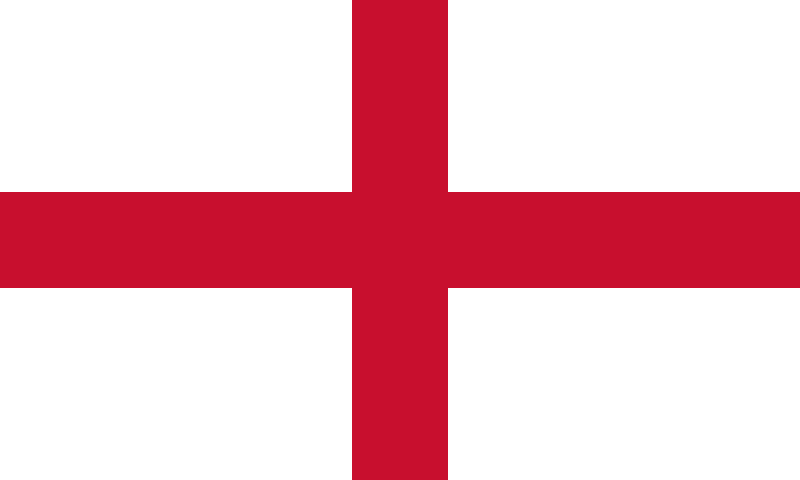 England England | London | 84% |
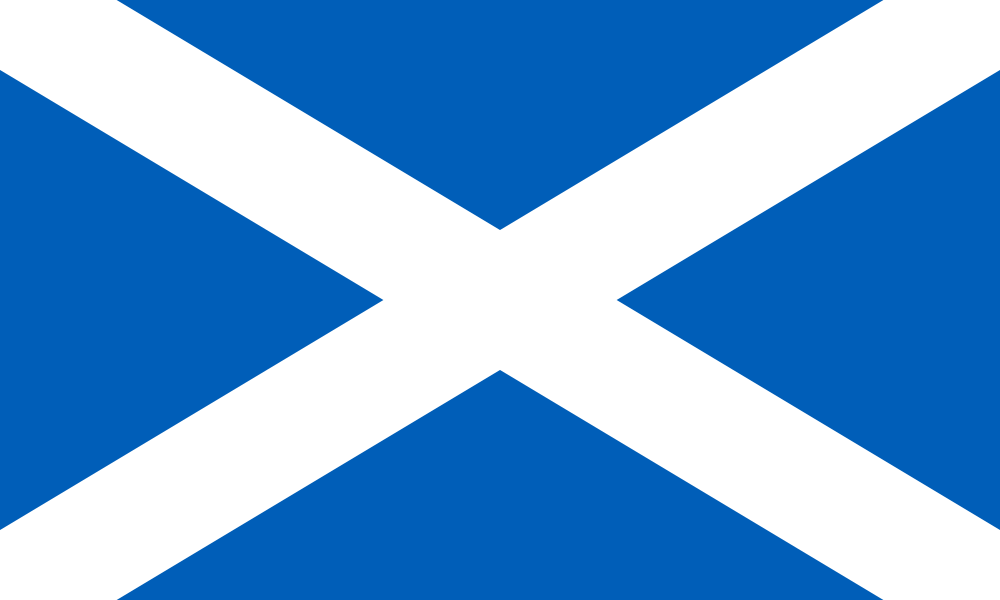 Scotland Scotland | Edinburgh | 8% |
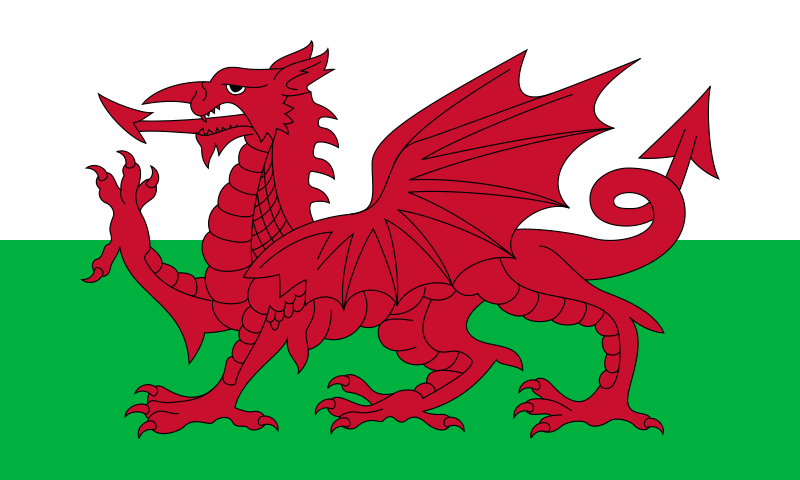 Wales Wales | Cardiff | 5% |
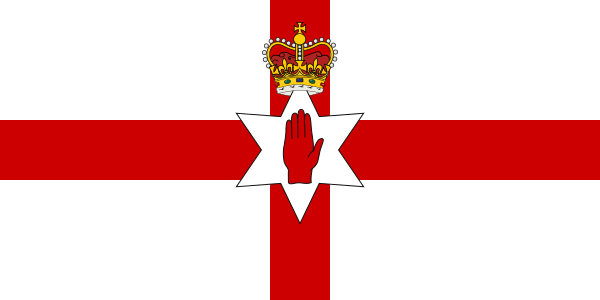 N. Ireland N. Ireland | Belfast | 3% |
| The UK | London |
Patron saints
| Country | Patron saint | Saint's day |
|---|---|---|
| England | Saint George | 23 AprilSt George's Day; no longer a public holiday, still celebrated. |
| Scotland | Saint Andrew | 30 NovemberSt Andrew's Day; an official holiday in Scotland, though not every business closes. |
| Wales | Saint David | 1 MarchSt David's Day. |
| N. Ireland | Saint Patrick | 17 MarchSt Patrick's Day; an official holiday in Northern Ireland. |
National flowers
| Country | Flower |
|---|---|
| England | rose |
| Scotland | thistle |
| Wales | daffodil |
| N. Ireland | shamrock |
Places in England
| Place | Where |
|---|---|
| Stonehenge | WiltshireProbably a gathering place for seasonal ceremonies, not a settlement. |
| Maiden Castle | DorsetAn Iron Age hill fort you can still see today. |
| Sutton Hoo | SuffolkAn Anglo-Saxon king's grave, with his treasure, in a ship under a mound. |
| The Eden Project | CornwallGiant greenhouses in the south-west of England. |
| The Lake District | EnglandEngland's largest national park; Wastwater there was voted Britain's favourite view in 2007. |
| Big Ben | the Houses of Parliament in LondonThe nickname of the great bell of the clock, not the tower. |
| 10 Downing Street | central LondonThe Prime Minister's official home, near the Houses of Parliament. |
| Hadrian's Wall | the north of EnglandBuilt by the Emperor Hadrian to keep out the Picts, the ancestors of the Scottish people. |
| Housesteads fort | Hadrian's WallOne of the wall's forts you can still walk to; the whole wall is a World Heritage Site. |
| Vindolanda fort | Hadrian's WallThe other fort on the wall that still stands. |
| The Danelaw | the east and north of EnglandWhere the Viking invaders settled and stayed; Grimsby and Scunthorpe are Viking names. |
| The statue of Boudicca | Westminster Bridge in LondonShe is still remembered: the statue stands near the Houses of Parliament. |
| The Globe Theatre | LondonIt recreates the Elizabethan theatres where Shakespeare's plays were first performed. |
| St Paul's Cathedral | LondonThe medieval cathedral burned in the Great Fire and was rebuilt by Christopher Wren. |
| The Hindoostane Coffee House | George Street, LondonBritain's first curry house, opened by Sake Dean Mahomet in 1810. |
| The Nightingale Training School for nurses | St Thomas' Hospital, LondonThe first nursing school of its kind, founded by Florence Nightingale and still open today. |
| Nelson's Column | Trafalgar Square, LondonCommemorates Admiral Nelson, who died at the Battle of Trafalgar in 1805. |
| HMS Victory | PortsmouthNelson's flagship at Trafalgar, preserved today as a visitor attraction. |
| The Great Exhibition | Hyde Park, LondonHeld in the purpose-built Crystal Palace, displaying exhibits from Britain and abroad. |
| Jodrell Bank | CheshireIts radio telescope was for many years the biggest in the world and still operates today. |
| The Royal Albert Hall | LondonWhere the Proms, eight weeks of concerts, end each September with the Last Night. |
| The O2 | Greenwich, south-east London |
| The National Gallery | LondonMore than 2,300 paintings, most of them from the 13th to the 19th century, free to see. |
| Tate Modern | London |
| The White Tower | the Tower of LondonBuilt by William the Conqueror after 1066; the Crown Jewels are kept there. |
| The Royal Crescent | BathIts design reflects architect Robert Adam’s influence on 18th-century style. |
| The Cenotaph | WhitehallWhere the wreaths are laid on Remembrance Day. |
| Hardwick Hall | Derbyshire |
| A famous celebration of Diwali | Leicester |
| The Aldeburgh festival | SuffolkComposer Benjamin Britten founded this festival, now internationally significant. |
| Dedham Vale | the Suffolk–Essex border in the east of EnglandConstable country: the landscape he painted. |
| The Queen’s House | Greenwich |
| The Banqueting House | Whitehall |
| Kew Gardens | EnglandA World Heritage Site, and home to the largest collection of living plants anywhere. |
| Sissinghurst | England |
| Hidcote | England |
| Wembley Stadium | LondonEngland's national football stadium, and where the FA Cup final is played. |
| The National Horseracing Museum | Newmarket, Suffolk |
| Cowes | the Isle of WightThe sailing regatta held there each August. |
| Land’s End | EnglandThe far south-west tip of the mainland. |
| The execution of Anne Boleyn | the Tower of LondonThe second of the six wives, and the mother of Elizabeth I. |
| Canals built during the Industrial Revolution | industrial areas of the middle and north of EnglandCanals linked new factories to towns, cities and ports as trade expanded. |
| The main site of the 2012 Olympic Games | Stratford, East London |
| The 2012 Paralympic Games | LondonHeld the same year as the London Olympics; the Paralympics trace back to Stoke Mandeville hospital's patients. |
| Stoke Mandeville hospital | BuckinghamshireStoke Mandeville hospital, where Paralympic sport began, is in Buckinghamshire. |
| Royal Ascot | BerkshireA five-day meeting attended by the Royal Family; not the same event as the Grand National at Aintree. |
| The Grand National | Aintree, near Liverpool |
| The first tennis club | Leamington Spa |
| The Wimbledon Championships | the All England Lawn Tennis and Croquet Club |
| The most famous sailing event in the UK | Cowes, Isle of Wight |
| The yearly rowing race between Oxford and Cambridge Universities | the ThamesThe handbook places the Oxford-Cambridge yearly rowing race on the Thames. |
| The Laurence Olivier Awards | LondonHeld every year at different venues in the city, for the theatre. |
Places in Scotland
| Place | Where |
|---|---|
| Skara Brae | OrkneyThe best-preserved prehistoric village in northern Europe. |
| Loch Lomond and the Trossachs National Park | the west of ScotlandA national park of 720 square miles. |
| The Scottish Parliament building at Holyrood | EdinburghWhere MSPs meet. |
| The monastery founded by St Columba | the island of IonaMissionaries from Ireland spread Christianity through the north from here. |
| The Scottish Exhibition and Conference Centre (SECC) | Glasgow |
| The National Gallery of Scotland | Edinburgh |
| Dumfries House | Scotland |
| Crathes Castle | Scotland |
| Inveraray Castle | Scotland |
| St Andrews | ScotlandWhere golf began, in the 15th century, and where its rules are still written. |
| John O’Groats | ScotlandThe far north-east tip of the mainland; the other end of the country from Land's End. |
| The Scottish Grand National | Ayr |
| Europe’s longest dry ski slope | near Edinburgh |
Places in Wales
| Place | Where |
|---|---|
| Snowdonia | North WalesA national park. |
| The Senedd | Cardiff BayWhere the Welsh Assembly meets. |
| Conwy Castle | WalesOne of the huge castles built to hold Wales after Edward I annexed it. |
| Caernarvon Castle | WalesThe other castle of the same campaign, built for the same reason. |
| The Dylan Thomas Centre | SwanseaThe centre in Swansea, Dylan Thomas's birthplace, is one of several memorials to the poet. |
| The National Museum | Cardiff |
| Bodnant Garden | Wales |
| The Millennium Stadium | Cardiff |
Places in N. Ireland
| Place | Where |
|---|---|
| The Giant's Causeway | Northern IrelandColumns of volcanic rock on the north-east coast. |
| Stormont | BelfastWhere the Northern Ireland Assembly meets. |
| Mount Stewart | Northern Ireland |
Languages
| What | Language |
|---|---|
| Wales | WelshTaught in schools and universities. |
| Scotland | GaelicSpoken in parts of the Highlands and Islands. |
| N. Ireland | Irish Gaelic |
Population over time
| The UK in | Population |
|---|---|
| 1600 | 4M |
| 1700 | 5M |
| 1801 | 8M |
| 1851 | 20M |
| 1901 | 40M |
| 1951 | 50M |
| 1998 | 57M |
| 2005 | 60M |
| 2010 | 62M |
| 2022 | 67.6M |
The UK at a glance
| What | Is |
|---|---|
| Currency | the pound sterlingWritten £, and there are 100 pence in a pound. |
| National anthem | God Save the KingPlayed at important national occasions and where the King or the Royal Family is present. |
| Official flag | the Union FlagOften called the Union Jack. Three crosses in one, and no Welsh dragon. |
| Head of state | the monarchGovernments and Prime Ministers change; the head of state does not. |
| Most popular sport | Football |
| Most well-known rugby league club competition | the Super LeagueThe handbook names the Super League as the best-known rugby league club competition. |
| Oldest tennis tournament | The Wimbledon ChampionshipsThe handbook calls Wimbledon the oldest tennis tournament in the world. |
| Only Grand Slam tennis tournament played on grass | The Wimbledon ChampionshipsThe handbook calls Wimbledon the only Grand Slam event played on grass. |
| Official name | the United Kingdom of Great Britain and Northern IrelandThe full name; 'Britain' and 'British' are used in the handbook for everyone in the UK. |
| Most famous rugby union competition | the Six Nations ChampionshipRugby union, not league; the Super League is the league game's competition. |
| System of government | a parliamentary democracyVoters in each constituency elect an MP; the monarch is head of state, Parliament governs. |
| Location | the north west of EuropeMade up of England, Scotland, Wales and Northern Ireland. |
Area
| What | Area |
|---|---|
| Loch Lomond and the Trossachs National Park | 720 square milesLoch Lomond is the largest stretch of fresh water in mainland Britain. |
| Snowdonia | 838 square milesIts best-known landmark is Snowdon. |
| The Lake District | 885 square milesEngland's largest national park, and its lakes and mountains draw the crowds. |
| The UK from end to end | about 870 miles, or 1,400 kilometresMeasured from the far north of Scotland to the south-west corner of England. |
Other places
| Place | Where |
|---|---|
| The Eid ul Adha animal sacrifice in Britain | a slaughterhouseWhere the sacrifice must legally take place in Britain. |
How the country is run
The parliaments and assemblies
| Body | Meets in | Members |
|---|---|---|
| The National Assembly for Wales | CardiffThe Welsh government is based there too. | 60Elected every four years by a form of proportional representation. |
| The Scottish Parliament | EdinburghAt Holyrood. | 129Elected by a form of proportional representation. |
| The Northern Ireland Assembly | BelfastAt Stormont. | 90Known as MLAs. |
| The UK Parliament | Westminster | |
| The UN Security Council | 15The UK holds one of the five permanent seats on this body. | |
| The Commonwealth | 5454, not the 56 in our copy's own list: that list adds Gabon and Togo, which joined in 2022. | |
| The Council of Europe | 47It protects and promotes human rights across its member countries. | |
| The United Nations | more than 190The UN was set up after the Second World War to promote peace and security. | |
| The European Union | 27The UK was one of them until it left. |
The courts
| Kind of case | England, Wales & N. Ireland | Scotland |
|---|---|---|
| Minor criminal cases | a Magistrates' CourtMagistrates are local people, usually unpaid and without legal qualifications. | a Justice of the Peace Court |
| Serious criminal offences | a Crown CourtTried in front of a judge and a jury. | a Sheriff CourtHeard by a sheriff, or a sheriff with a jury. |
| Cases against someone aged 10 to 17 | a Youth CourtUp to three trained magistrates, no public, and no naming the young person. | the Children's Hearings SystemNot a court: a separate system for children who have offended. |
| Civil disputes over money, injury or divorce | a County CourtDebts, personal injury, family matters, broken contracts. | the Sheriff CourtThe same court that takes serious criminal cases. |
| Civil claims for a large amount of compensation | the High Court | the Court of Session in Edinburgh |
| The gravest cases, such as murder | a High CourtA judge and a jury, for the cases a Sheriff Court does not take. |
Juries and verdicts
| Where | Jurors | Verdicts |
|---|---|---|
| England, Wales and Northern Ireland | 12Jurors are picked at random from the local electoral register. | guilty or not guilty |
| Scotland | 15Three more than the rest of the UK. | guilty, not guilty or not provenThe third verdict is the one thing about a Scottish trial everyone is asked. |
Small claims limits
| Where | Limit |
|---|---|
| England and Wales | £10,000An informal hearing in front of a judge, round a table, without a lawyer. |
| Scotland | £5,000 |
| N. Ireland | £5,000The same limit as Scotland, half the one in England and Wales. |
Who sat in them
| What | Made up of |
|---|---|
| The House of Commons | the elected MPsMPs are chosen by voters in a General Election, one per constituency. |
| The House of Lords | peers, who are not elected and do not represent a constituencyPeers do not represent a constituency. |
| The House of Lords, until 1958 | hereditary peers, senior judges, or bishops of the Church of EnglandPeerages passed from father to son, so the chamber was inherited rather than appointed. |
| The opposition | the second-largest party in the House of CommonsThe opposition leader usually becomes PM if their party wins the next election. |
| The UN Security Council | five permanent members, including the UKIt recommends action when there is a threat to international peace. |
| The cabinet | the ministers the Prime Minister appoints to run government departmentsThe cabinet usually meets weekly to decide government policy. |
| The shadow cabinet | senior opposition MPs, known as shadow ministersThe shadow cabinet challenges the government and proposes alternative policies. |
Voting systems
| What | Elected by |
|---|---|
| The House of Commons | first past the postThe candidate with the most votes in a constituency wins it, whoever else stood. |
| The European Parliament | a system of proportional representationSeats go to each party in proportion to the votes it won. |
| The National Assembly for Wales | a form of proportional representationMembers are called AMs and serve four-year terms. |
| The Scottish Parliament | a form of proportional representation |
| The Northern Ireland Assembly | a form of proportional representation |
Roles and duties
| What | Responsible for |
|---|---|
| The Prime Minister | making decisions on government policiesThe leader of the party in power, who also appoints the ministers who run the departments. |
| The cabinet | making decisions about government policy with the Prime Minister |
| The monarch | opening the new parliamentary session each yearThe speech at the opening sets out the government's policies for the year ahead. |
| An MP | representing everyone in their constituency, helping to create new laws, and scrutinising what the government is doingAlso making laws, scrutinising the government and debating national issues. |
| The House of Lords | checking the laws the House of Commons passesIt can hold the government to account and suggest amendments, but not block a law for ever. |
| The Speaker | chairing debates in the House of Commons, keeping order, and representing Parliament on ceremonial occasionsChosen by the other MPs in a secret ballot, and still an MP for their own constituency. |
| HMRC | collecting taxesIncome tax, National Insurance and the rest. |
| The Chancellor of the Exchequer | the economy |
| The Home Secretary | crime, policing and immigration |
| The Foreign Secretary | managing relationships with foreign countries |
| The Council of Europe | the protection and promotion of human rights in its member countriesIts best-known text is the European Convention on Human Rights. |
| The licensee | deciding the hours that the pub or night club is openNot the law, and not a fixed closing time: the licensee sets the hours. |
| The owner of a dog in a public place | keeping the dog under control, cleaning up after it, and making sure it wears a collar showing the owner's name and addressIt is against the law to treat a pet cruelly or to neglect it. |
| New citizens at the citizenship ceremony | swearing or affirming loyalty to the KingPart of the ceremony at which someone becomes a British citizen. |
| The police | protecting life and property, preventing disturbances (keeping the peace), and preventing and detecting crimeEveryone in the UK is expected to help the police prevent and detect crime when they can. |
| The judiciary | interpreting the law and ensuring that trials are conducted fairlyThe judiciary is all the judges together. |
| The judge | deciding on the penalty when the jury finds a defendant guiltyThe jury decides guilt from the evidence; the judge decides what follows. |
| Secretaries of State | subjects such as education, health and defenceThe cabinet ministers other than the Chancellor, the Home Secretary and the Foreign Secretary. |
| The leader of the opposition | leading their party in pointing out what they see as the government's failures and weaknessesPrime Minister's Questions is one important chance to do it. |
| All those living in the UK | respecting and supporting the fundamental values and principles British society is founded onNot only citizens: the values apply to everyone who lives in the UK. |
| Civil servants | supporting the government in developing and implementing its policies, and delivering public servicesChosen on merit and politically neutral, not political appointees; accountable to ministers. |
Age limits
| What | Age |
|---|---|
| Drive a car or motorcycle | 17And you need a licence, which means passing a test of both knowledge and skill. |
| Ride a moped | 16 |
| Buy alcohol in a pub or night club | 18Selling it to someone younger, or buying it for them, is a criminal offence. |
| Drink alcohol with a meal in a hotel or restaurant | 16The one exception to the rule that alcohol is for over-18s. |
| Stand for election as an MP | 18Though winning without a major party behind you is rare. |
| Serve on a jury | 18It follows the electoral register rather than citizenship, which catches people out. |
| Become a school governor or school board member | 18Unlike jury service there is no upper limit here, which is the kind of asymmetry the test likes to probe. |
| Join the National Citizen Service | 16The only youth-specific age gate in this chapter, easy to confuse with the jury service age. |
| Apply for a free TV licence | 75The handbook says people over 75. Blind people get a 50% discount; watching TV without a licence brings a fine of up to £1,000. |
| Go into a betting shop or gambling club | 18There are also casinos in many places. |
| Buy a National Lottery ticket or scratch card | 18The minimum rose from 16 to 18 in April 2021, so older practice questions may still say 16. |
Culture, customs and the calendar
The calendar
January
- 1New Year
February
- 14Valentine’s Day
March
- 1Wales's patron saint's daySt David's Day.
- 17Northern Ireland's patron saint's daySt Patrick's Day; an official holiday in Northern Ireland.
April
- 1April Fool’s DayJokes are played only until midday.
- 14VaisakhiIt is a Sikh festival celebrating the founding of the Khalsa community.
- 23England's patron saint's daySt George's Day; no longer a public holiday, still celebrated.
May
June
July
August
September
October
- 31HalloweenIt has roots in a pagan festival marking the start of winter.
November
- 5Bonfire Night
- 11Remembrance DayOriginally it commemorated the dead of the First World War.
- 30Scotland's patron saint's daySt Andrew's Day; an official holiday in Scotland, though not every business closes.
December
- 24Christmas Eve
- 25Christmas Day
- 31New Year’s Eve
- 31HogmanayFor some Scottish people, Hogmanay is a bigger holiday than Christmas.
Moves each year
- Boxing Daythe day after Christmas Day
- Shrove Tuesday, or Pancake Daythe day before Lent starts
- Mothering Sunday, or Mother’s Daythe Sunday three weeks before Easter
- Father’s Daythe third Sunday in June
- EasterMarch or April
- Lentthe 40 days before Easter
- DiwaliOctober or November
- HannukahNovember or December
- Eid al-Fitra different day each year
Who they were
Writers and composers
Graham Greene
- The Heart of the Matter
- The Honorary Consul
- Brighton Rock
- Our Man in Havana
Benjamin Britten
- Peter Grimes
- Billy Budd
- A Young Person's Guide to the OrchestraBuilt on a piece of music by Purcell, to introduce the instruments of an orchestra.
Evelyn Waugh
- Decline and Fall
- Scoop
- Brideshead Revisited
George Frederick Handel
- the Water MusicHandel wrote it for King George I.
- Music for the Royal FireworksHandel wrote it for George II.
- MessiahThis oratorio is sung regularly by choirs, often at Easter time.
Gilbert and Sullivan
- HMS Pinafore
- The Pirates of Penzance
- The Mikado
Robert Louis Stevenson
- Treasure Island
- Kidnapped
- Dr Jekyll and Mr Hyde
Andrew Lloyd Webber
- Cats
- The Phantom of the Opera
Andrew Lloyd Webber and Tim Rice
- Jesus Christ Superstar
- Evita
Charles Dickens
- Oliver Twist
- Great Expectations
Dylan Thomas
- Under Milk WoodA radio play, first performed after his death in 1954.
- Do Not Go Gentle into That Good NightA poem he wrote for his dying father in 1952.
Jane Austen
- Pride and Prejudice
- Sense and Sensibility
Sir William Walton
- FaçadeIt later became a ballet.
- Balthazar's FeastWritten to be sung by a large choir.
Thomas Hardy
- Far from the Madding Crowd
- Jude the Obscure
Dame Agatha Christie
- The MousetrapIt has had the longest initial run of any show in West End history.
Geoffrey Chaucer
- Canterbury Tales
Gustav Holst
- The PlanetsIt is a suite of pieces themed around the planets of the solar system.
J K Rowling
- the Harry Potter series
John Milton
- Paradise LostMilton wrote it as Protestant ideas spread among English poets.
JRR Tolkien
- The Lord of the RingsIn 2003 it was voted the country’s best-loved novel.
Lord Byron
- She Walks in Beauty
Roald Dahl
- Charlie and the Chocolate FactoryOne of his best-known children's books, with George's Marvellous Medicine.
Robert Browning
- Home Thoughts from Abroad
Robert Burns
- Auld Lang SyneSung at the New Year in the UK and other countries.
Samuel Pepys
- a diary of the Great Plague and the Great Fire of LondonPublished later and still read today.
Sir Edward Elgar
- the Pomp and Circumstance MarchesMarch No 1, Land of Hope and Glory, is usually played at the Last Night of the Proms.
Sir Kingsley Amis
- Lucky Jim
Wilfred Owen
- Anthem for Doomed YouthOwen was inspired to write about his experiences in the First World War.
William Blake
- The Tyger
William Shakespeare
- HamletWith A Midsummer Night's Dream, Macbeth and Romeo and Juliet, one of his most famous plays.
William Wordsworth
- The Daffodils
Who led what
Oliver Cromwell
- the new republicCromwell became head of the Commonwealth after defeating royalist forces.
- the campaign in IrelandCromwell's harsh suppression of the revolt still makes him a divisive figure in Ireland.
William, Duke of Normandy
- the invasion of 1066Won at Hastings and became king: William the Conqueror.
- the survey that produced the Domesday BookEvery town and village listed, with who lived there and what they owned, just after the Conquest.
Aneurin (Nye) Bevan
- the establishment of the National Health ServiceBevan, as Minister for Health, drove the NHS into being as a free, universal service.
Bobby Moore
- the England football team that won the 1966 World CupThat 1966 tournament was hosted in the UK and remains England's only World Cup win.
Boudicca
- the Iceni's revolt against the RomansQueen of a tribe in what is now eastern England, and the resistance to Rome that is still remembered.
Charles II
- the Scottish invasion of EnglandCharles II tried to reclaim the English throne by force after his father's execution.
Elizabeth I
- the restoration of the Church of England as the national church of EnglandAfter Mary’s Catholic reign, Elizabeth restored the Protestant church but did not police private belief.
Ernest Rutherford
- the team that first split the atomTheir work at Manchester and Cambridge fed into the Manhattan Project.
Guy Fawkes
- the Gunpowder Plot
Henry Tudor
- the House of Lancaster at the Battle of Bosworth FieldHe won, took the throne as Henry VII, and the House of Tudor began.
Henry V
- the English at the Battle of Agincourt
Henry VIII
- the founding of the Church of EnglandThe Break with Rome: England left the Pope for a national church under the Crown.
Julius Caesar
- the Roman invasion of 55 BC
Kenneth MacAlpin
- the peoples of the north uniting against the VikingsThe union the name Scotland was first used to describe.
King Alfred the Great
- the Anglo-Saxon kingdoms uniting against the VikingsHe defeated the Vikings, but many of them stayed and mixed with local communities.
King Charles III
- the CommonwealthThe monarch has no power over Commonwealth members, though membership can be suspended.
King James I
- plantations in several other parts of IrelandJames extended the plantation policy of settling Protestants on Irish land.
Lord Horatio Nelson
- the Battle of TrafalgarNelson's Column in London commemorates him.
Lord Wellington
- the Battle of Waterloo
Margaret Thatcher
- the Conservative government from 1979 to 1990Thatcher led sweeping privatisation and trade union reform during her decade in office.
Robert the Bruce
- the Battle of BannockburnThe Scottish king who won at Bannockburn.
Sir Francis Drake
- the circumnavigation of the world in the Golden HindDrake's ship became one of the first to sail all the way around the world.
Sir Ian Botham
- the England cricket team of the 1980sBotham captained England and holds English Test cricket records.
Sir Ian Wilmot and Keith Campbell
- the team that first cloned a mammalTheir work made Dolly the first mammal ever cloned.
St Augustine
- the mission that brought Christianity to the southHe became the first Archbishop of Canterbury.
the Archbishop of Canterbury
- the Church of EnglandThe monarch is its head; the Archbishop of Canterbury leads it in spiritual matters.
the Emperor Claudius
- the Roman invasion of AD 43Claudius's invasion is the one that succeeded, unlike Caesar's.
the Moderator
- the General Assembly of the Church of ScotlandThe Moderator is appointed for one year only.
Winston Churchill
- Britain in the Second World WarHe became Prime Minister in May 1940, as German forces advanced through France, and refused to surrender.
Architects and designers
Inigo Jones
- the Queen’s House at Greenwich
- the Banqueting House in Whitehall
Clarice Cliff
- Art Deco ceramics in Britain
Richard Arkwright
- horse-driven spinning mills that used only one machineHis single-machine mills raised production efficiency in the early textile industry.
Robert Adam
- Dumfries House
Sir Christopher Wren
- the new St Paul’s Cathedral
Sir Edwin Lutyens
- The Cenotaph in WhitehallSir Edwin Lutyens was responsible for the Cenotaph among his many war memorials.
Thomas Chippendale
- 18th-century British furniture design
Festivals
| Festival | Celebrated by | Lasts |
|---|---|---|
| Diwali | Hindus and SikhsDiwali is kept by Hindus and Sikhs. | five daysDiwali runs for five days. |
| Vaisakhi | SikhsVaisakhi is a Sikh festival. | |
| Hannukah | JewsHannukah is a Jewish festival. | eight daysHannukah runs for eight days. |
| The requirement for a newly qualified driver in Northern Ireland to display an R plate | one year after passing the testR for restricted driver; Northern Ireland only. | |
| The right to drive in the UK on a licence from the EU, Iceland, Liechtenstein or Norway | as long as the licence is validAny other country's licence is good for up to 12 months. | |
| The right to drive in the UK on a licence from any other country | up to 12 monthsAfter that you need a UK licence; EU, Icelandic, Liechtenstein and Norwegian licences last while valid. |
Builders and designers
| What | Built by | Designed by |
|---|---|---|
| Tower of London | William the ConquerorThe Tower of London was first built by William the Conqueror. | |
| The White Tower | William the ConquerorThe White Tower, in the Tower of London, was built on William the Conqueror's orders. | |
| The Queen’s House at Greenwich | Inigo Jones | |
| The Banqueting House in Whitehall | Inigo Jones | |
| The new St Paul’s Cathedral | Sir Christopher Wren | |
| Dumfries House | Robert Adam | |
| 18th-century British furniture design | Thomas Chippendale | |
| Art Deco ceramics in Britain | Clarice Cliff | |
| The Cenotaph in Whitehall | Sir Edwin LutyensSir Edwin Lutyens was responsible for the Cenotaph among his many war memorials. |
Leaders
| What | Led by |
|---|---|
| The Commonwealth | King Charles IIIThe monarch has no power over Commonwealth members, though membership can be suspended. |
| The Gunpowder Plot | Guy Fawkes |
| The Church of England | the Archbishop of CanterburyThe monarch is its head; the Archbishop of Canterbury leads it in spiritual matters. |
| The General Assembly of the Church of Scotland | the ModeratorThe Moderator is appointed for one year only. |
| The England cricket team of the 1980s | Sir Ian BothamBotham captained England and holds English Test cricket records. |
Key dates
| What | Year |
|---|---|
| The Turner Prize being established | 1984It is named after painter Joseph Turner and celebrates contemporary art. |
| The Mousetrap opening in London | 1952It has been running ever since, the longest-running play anywhere. |
| The Man Booker Prize for Fiction being founded | 1968It is awarded for the best fiction novel by an author from the Commonwealth, Ireland or Zimbabwe. |
| The release of The 39 Steps | 1935Alfred Hitchcock directed this 1935 British film. |
| The release of Brief Encounter | 1945 |
| The release of The Third Man | 1949 |
| The release of Lawrence of Arabia | 1962 |
| The release of Women in Love | 1969 |
| The release of Don't Look Now | 1973 |
| The release of Chariots of Fire | 1981 |
| The release of The Killing Fields | 1984 |
| The release of Four Weddings and a Funeral | 1994 |
| The release of Touching the Void | 2003 |
| England winning the football World Cup | 1966England's only World Cup win came in 1966, on home soil. |
| Films first being shown publicly in the UK | 1896Screenings quickly became popular; British studios flourished in the 1930s. |
Writers and works
| What | Written by |
|---|---|
| The Water Music | George Frederick HandelHandel wrote it for King George I. |
| Music for the Royal Fireworks | George Frederick HandelHandel wrote it for George II. |
| Messiah | George Frederick HandelThis oratorio is sung regularly by choirs, often at Easter time. |
| The Planets | Gustav HolstIt is a suite of pieces themed around the planets of the solar system. |
| The Pomp and Circumstance Marches | Sir Edward ElgarMarch No 1, Land of Hope and Glory, is usually played at the Last Night of the Proms. |
| Façade | Sir William WaltonIt later became a ballet. |
| Balthazar's Feast | Sir William WaltonWritten to be sung by a large choir. |
| Peter Grimes | Benjamin Britten |
| Billy Budd | Benjamin Britten |
| A Young Person's Guide to the Orchestra | Benjamin BrittenBuilt on a piece of music by Purcell, to introduce the instruments of an orchestra. |
| HMS Pinafore | Gilbert and Sullivan |
| The Pirates of Penzance | Gilbert and Sullivan |
| The Mikado | Gilbert and Sullivan |
| Jesus Christ Superstar | Andrew Lloyd Webber and Tim Rice |
| Evita | Andrew Lloyd Webber and Tim Rice |
| Cats | Andrew Lloyd Webber |
| The Phantom of the Opera | Andrew Lloyd Webber |
| Paradise Lost | John MiltonMilton wrote it as Protestant ideas spread among English poets. |
| Canterbury Tales | Geoffrey Chaucer |
| Home Thoughts from Abroad | Robert Browning |
| She Walks in Beauty | Lord Byron |
| The Daffodils | William Wordsworth |
| The Tyger | William Blake |
| Anthem for Doomed Youth | Wilfred OwenOwen was inspired to write about his experiences in the First World War. |
| Pride and Prejudice | Jane Austen |
| Sense and Sensibility | Jane Austen |
| Oliver Twist | Charles Dickens |
| Great Expectations | Charles Dickens |
| Treasure Island | Robert Louis Stevenson |
| Kidnapped | Robert Louis Stevenson |
| Dr Jekyll and Mr Hyde | Robert Louis Stevenson |
| Far from the Madding Crowd | Thomas Hardy |
| Jude the Obscure | Thomas Hardy |
| Decline and Fall | Evelyn Waugh |
| Scoop | Evelyn Waugh |
| Brideshead Revisited | Evelyn Waugh |
| Lucky Jim | Sir Kingsley Amis |
| The Heart of the Matter | Graham Greene |
| The Honorary Consul | Graham Greene |
| Brighton Rock | Graham Greene |
| Our Man in Havana | Graham Greene |
| The Harry Potter series | J K Rowling |
| The Mousetrap | Dame Agatha ChristieIt has had the longest initial run of any show in West End history. |
| The Lord of the Rings | JRR TolkienIn 2003 it was voted the country’s best-loved novel. |
Days of the year
| What | Date |
|---|---|
| Christmas Day | 25 December |
| Christmas Eve | 24 December |
| Boxing Day | the day after Christmas Day |
| Shrove Tuesday, or Pancake Day | the day before Lent startsPeople eat pancakes to use up foods like eggs, fat and milk before fasting. |
| Vaisakhi | 14 AprilIt is a Sikh festival celebrating the founding of the Khalsa community. |
| New Year | 1 January |
| New Year’s Eve | 31 December |
| Hogmanay | 31 DecemberFor some Scottish people, Hogmanay is a bigger holiday than Christmas. |
| Valentine’s Day | 14 February |
| April Fool’s Day | 1 AprilJokes are played only until midday. |
| Mothering Sunday, or Mother’s Day | the Sunday three weeks before Easter |
| Father’s Day | the third Sunday in June |
| Halloween | 31 OctoberIt has roots in a pagan festival marking the start of winter. |
| Bonfire Night | 5 November |
| Remembrance Day | 11 NovemberOriginally it commemorated the dead of the First World War. |
| Easter | March or AprilEaster is also celebrated by people who are not religious, with chocolate eggs as a symbol of new life. |
| Lent | the 40 days before EasterWhen Lent falls relative to Easter. |
| Diwali | October or NovemberWhen Diwali falls in the year. |
| Hannukah | November or DecemberWhen Hannukah falls in the year. |
| Eid al-Fitr | a different day each yearWhether Eid al-Fitr falls on a fixed date. |
Prizes
| What | Awarded for |
|---|---|
| The Mercury Music Prize | the best album from the UK and IrelandAwarded each September. |
| The Brit Awards | best British group and best British solo artist |
| The Man Booker Prize for Fiction | the best fiction novel by an author from the Commonwealth, Ireland or ZimbabweAwarded annually since 1968. |
| The Turner Prize | contemporary artNamed after painter Joseph Turner. |
| The Laurence Olivier Awards | best director, best actor and best actressFor the theatre, in a range of categories. |
| Torvill and Dean’s Olympic gold medals | ice dancing |
| Sir Steve Redgrave’s Olympic gold medals | rowing |
| Dame Kelly Holmes’s Olympic gold medals | running |
| Ellie Simmonds’s Paralympic gold medals | swimming |
People and religion
| What | Share |
|---|---|
| Christian | 70%The UK is historically a Christian country. |
| Of no religion | 21%Everyone has the legal right to choose a religion, or to practise none. |
| Muslim | 4% |
| Hindu | 2% |
| Sikh | 1% |
| Of another religion | 2%Jewish and Buddhist were each under 0.5% in the same survey. |
What each one includes
| What | Made up of |
|---|---|
| The fundamental principles of British life | democracy, the rule of law, individual liberty, tolerance of different faiths and beliefs, and participation in community lifeThese five principles are set out as the basis British society is founded on. |
| The pledge new citizens speak at the citizenship ceremony | a declaration of loyalty to the United Kingdom, respect for its rights and freedoms, support for its democratic values, and a promise to observe its laws and fulfil civic dutiesThis is the spoken pledge new citizens make as part of the citizenship ceremony. |
| The responsibilities of someone who wants to be a permanent resident or citizen of the UK | obeying the law, respecting other people's rights and opinions, treating others fairly, looking after yourself and your family, and looking after your local area and the environmentThese five duties are listed as what is expected of residents in return for the freedoms below. |
| What the UK offers in return to permanent residents and citizens | the freedom to hold your own beliefs and religion, freedom of speech, freedom from unfair discrimination, the right to a fair trial, and the right to help elect a governmentThese five freedoms are presented as the reciprocal side of the responsibilities expected of residents. |
| The role of school governors and school boards | setting the schools strategic direction, ensuring accountability, and monitoring and evaluating school performanceThree named roles, which is exactly the kind of triad the test likes to list back in a different order. |
| Public offices British citizens can stand for | local councillor, Member of Parliament or its devolved equivalent, and Member of the European ParliamentDistinguishes standing for office from the separate right to vote. |
| Nationalities besides British citizens who may stand for public office | Irish citizens, eligible Commonwealth citizens, and citizens of another EU country except for standing as an MPThe MP exception is the trap: those three groups can stand for other offices but not Parliament. |
| Ways to volunteer with the police | becoming a special constable or a lay, non-police, representativeShows volunteering with the police does not require becoming a police officer. |
| Ways to look after the environment | recycling waste, shopping for products locally, and walking or using public transport instead of drivingThe three headline actions of section 5.8.2, likely tested together as a single which-of-these question. |
| The heptathlon | seven different track and field events |
| The Ashes | Test matches between England and AustraliaThe handbook describes the Ashes as a Test match series between England and Australia. |
| Rugby | union and league |
| The Six Nations Championship | England, Ireland, Scotland, Wales, France and ItalyThe handbook names the six competing nations in the Six Nations Championship. |
| The menorah | eight candles, one lit on each day of the festivalWhat a menorah is made up of. |
| Giant’s Causeway | columns formed from volcanic lavaThe Giant's Causeway is a rock formation made of lava columns. |
| The traditional pub games | pool and dartsPub quizzes are popular too, though the handbook does not call them a game. |
| The Crown dependencies | the Channel Islands and the Isle of ManClosely linked with the UK, with their own governments, and not part of it. |
| British overseas territories | St Helena and the Falkland IslandsThe handbook's two examples; linked to the UK, in other parts of the world, not part of it. |
| Great Britain | England, Scotland and WalesOnly those three. Northern Ireland is in the UK but not in Great Britain. |
| What you need to apply to become a permanent resident or citizen of the UK | speaking and reading English, and a good understanding of life in the UKTwo things, and this course is the second of them. |
| The famous horse-racing events the handbook names | Royal Ascot, the Grand National and the Scottish Grand NationalBerkshire, Aintree near Liverpool, and Ayr. |
| The core values of the civil service | integrity, honesty, objectivity and impartialityImpartiality includes being politically neutral; civil servants stay when governments change. |
| The six changes the Chartists campaigned for | the vote for every man, elections every year, equal electoral regions, secret ballots, any man being able to stand as an MP, and MPs being paidA campaign of the 1830s and 1840s, when only men over 21 with property could vote. |
| The main parts of government in the UK | the monarchy, Parliament, the Prime Minister, the cabinet, the judiciary, the police, the civil service and local governmentEight parts in the handbook's list; Parliament means both Houses and the judiciary means the courts. |
| The independent bodies that take complaints about the police | the Independent Police Complaints Commission in England and Wales, the Police Complaints Commissioner for Scotland, and the Police Ombudsman for Northern IrelandThe other route is a police station, or a letter to the Chief Constable of the force involved. |
| The personal characteristics UK law protects from unfair treatment | age, disability, sex, pregnancy and maternity, race, religion or belief, sexuality, and marital statusIn any area of life or work; eight in the handbook's list. |
| The exceptions to who can stand for public office | members of the armed forces, civil servants, and people found guilty of certain criminal offencesMost citizens of the UK, Ireland or the Commonwealth aged 18 or over can stand; peers may not stand for the Commons. |
| The income people in the UK have to pay tax on | wages from paid employment, profits from self-employment, taxable benefits, pensions, and income from property, savings and dividendsIncome tax pays for services such as roads, education, the police and the armed forces. |
| The driving test | a test of your knowledge and a test of your practical skillsYou must pass it to get a UK driving licence, and you need a licence to drive on public roads. |
| The two kinds of law in the UK | criminal law and civil lawCrimes are investigated by the police and punished by the courts; civil law settles disputes between people. |
| Examples of criminal offences in the UK | carrying a weapon, buying or selling illegal drugs, causing harassment because of someone's religion or ethnic origin, selling tobacco to under-18s, smoking in enclosed public places, selling alcohol to under-18s, and drinking in an alcohol-free zoneThe handbook's list; it says it is not all crimes, and murder, theft and assault apply in most countries. |
| Examples of civil law in the UK | housing law, consumer rights, employment law and debtNone of these is a crime: a dispute over faulty goods or an unpaid debt goes to a civil court. |
| The ways to arrange a visit to the Northern Ireland Assembly at Stormont | contacting the Education Service or contacting an MLAMLA: a Member of the Legislative Assembly. |
| The matters on which the Scottish Parliament can legislate | civil and criminal law, health, education, planning and additional tax-raising powersAnything not specifically reserved to the UK Parliament. |
| The issues the Northern Ireland Assembly can make decisions on | education, agriculture, the environment, health and social servicesThe handbook's list for Northern Ireland; note that planning appears only in Scotland's. |
| The core values of the Commonwealth | democracy, good government and the rule of lawIt has no power over its members, though it can suspend membership. |
| Activities schools might organise to raise money | book sales, toy sales and bringing food to sellFor extra equipment or out-of-school activities; parent-teacher associations often run them. |
| What you need for settlement or permanent residence from October 2013 | passing the Life in the UK test, and evidence of speaking and listening skills in English at B1 of the Common European Framework of ReferenceB1 is the same level as ESOL Entry Level 3. |
| What you need to bring to the Life in the UK test | some identification and proof of your addressWithout them you will not be able to take the test. |
| What you agree to when applying to become a permanent resident or citizen of the UK | accepting the responsibilities that come with permanent residence, and respecting the laws, values and traditions of the UKThe handbook calls the application an important decision and commitment. |
| The major political parties in the UK | the Conservative Party, the Labour Party, the Liberal Democrats, and parties representing Scottish, Welsh or Northern Irish interestsA candidate is unlikely to win a seat unless nominated by one of them. |
| The UK | England, Scotland, Wales and Northern IrelandGreat Britain is only England, Scotland and Wales. |
| Examples of the poets popular in the 19th century | William Blake, John Keats, Lord Byron, Percy Shelley, Alfred Lord Tennyson, and Robert and Elizabeth BrowningPoetry was very popular then, the handbook says. |
Who is in charge
| What | Responsible |
|---|---|
| Protecting Britain's fundamental values and principles | law, custom, and expectationThe handbook grounds these values in legal protection as well as social custom, not statute alone. |
| Raising school standards | school governors and school boardsNames the body without naming an individual, which is how the source frames accountability here. |
| Recycling information in Northern Ireland | the local authorityNorthern Ireland is the odd one out: the other three nations each have a named website, NI does not. |
| Registering a car or motorcycle if you live in the UK | the Driver and Vehicle Licensing Agency (DVLA)It also issues driving licences. |
| Arranging a National Insurance number for someone with permission to work in the UK | the Department for Work and Pensions (DWP)You telephone the DWP to arrange it; you can start work before it arrives. |
| Paying National Insurance Contributions | almost everybody in the UK who is in paid work, including self-employed peopleThe money pays for state benefits and services such as the state pension and the NHS. |
| Telling you the reason for your arrest | a police officerAt the police station; you will also be able to seek legal advice. |
| Policy and laws on defence, foreign affairs, immigration, taxation and social security | the central UK governmentThe matters kept back from the devolved administrations. |
| Arranging a booking to visit the Welsh Assembly | the Assembly Booking ServiceThe Senedd is an open building: guided tours, or seats in the public galleries. |
| Registering to vote | your local council electoral registration officeUsually based at the local council; you must be on the register to vote in any election. |
| Appointing life peers | the monarch, on the advice of the Prime MinisterNominated by the Prime Minister, the other main parties' leaders or an independent Appointments Commission; the PM's power dates from 1958. |
| Advising, warning and encouraging the Prime Minister | the monarchIn regular meetings; the decisions on policy are the Prime Minister's and the cabinet's. |
| Appointing the government, which the people have chosen in a democratic election | the monarchThe monarch invites the leader of the party with most MPs, or of a coalition, to be Prime Minister. |
| Public services such as education, in Scotland, Wales and Northern Ireland | the devolved administrationsDefence, foreign affairs, immigration, taxation and social security stay with the UK government. |
Known for
| What | Known for |
|---|---|
| Christmas Day | the birth of Jesus ChristWhat Christmas Day marks. |
| Boxing Day | the day after Christmas Day, and a public holidayWhat Boxing Day is. |
| Good Friday | the day marking the death of Jesus ChristWhat Good Friday marks. |
| Easter Sunday | the day marking Jesus Christ rising from the deadWhat Easter Sunday marks. |
| Lent | a time for Christians to reflect and prepare for EasterWhat Lent is a time for. |
| The Easter egg | chocolate eggs given as gifts at Easter, symbolising new lifeWhat Easter eggs symbolise. |
| Shrove Tuesday | the day before Lent begins, also called Pancake DayWhat Shrove Tuesday is. |
| Pancake Day | eating pancakes, traditionally made to use up eggs, fat and milk before fastingWhy pancakes are eaten on this day. |
| Ash Wednesday | church services marking Christians with an ash cross as a sign of mortality and sorrow for sinWhat happens at Ash Wednesday services. |
| Diwali | the victory of good over evil and the gaining of knowledgeWhat Diwali celebrates. |
| Hannukah | remembering the Jews’ struggle for religious freedomWhat Hannukah remembers. |
| The menorah lighting | the story of oil that lasted eight days instead of oneThe story behind lighting the menorah. |
| Eid al-Fitr | marking the end of RamadanWhat Eid al-Fitr marks. |
| Ramadan | a month when Muslims fastWhat Ramadan is. |
| Eid ul Adha | the prophet Ibrahim being willing to sacrifice his son when God commanded itWhat Eid ul Adha remembers. |
| Vaisakhi | the founding of the Sikh community, the KhalsaWhat Vaisakhi celebrates. |
| Valentine’s Day | an occasion for lovers to exchange cards and giftsWhat Valentine’s Day is for. |
| April Fool’s Day | people playing jokes on each other until middayWhat happens on April Fool’s Day. |
| Mothering Sunday | children sending cards or buying gifts for their mothersWhat people do on Mothering Sunday. |
| Father’s Day | children sending cards or buying gifts for their fathersWhat people do on Father’s Day. |
| Halloween | an ancient festival rooted in a pagan marking of the start of winterWhere Halloween customs come from. |
| Bonfire Night | a failed 1605 plot by Guy Fawkes and other Catholics to kill the king in Parliament with a bombThe origin of Bonfire Night. |
| Remembrance Day | commemorating those who died fighting for the UK and its alliesWhat Remembrance Day commemorates. |
| Tower of London | housing the Crown JewelsVisitors to the Tower of London can see the Crown Jewels there. |
| The White Tower | being an example of a Norman castle keepThe White Tower is an example of a Norman-era castle keep. |
| The Cenotaph in Whitehall | being the site of the yearly Remembrance Day serviceThe Cenotaph hosts the UK's annual Remembrance Day service. |
| The Eden Project | its biomes that hold plants gathered from around the worldThe Eden Project's biomes are giant greenhouses holding plants from around the world. |
| Loch Lomond | being the biggest area of fresh water in mainland BritainLoch Lomond is mainland Britain's biggest area of fresh water. |
| Snowdonia | being home to Snowdon, the highest peak in WalesSnowdonia's best-known feature is Snowdon, the highest mountain in Wales. |
| The Lake District | its lakes and mountains, and popularity with climbers, walkers and sailorsThe Lake District is loved for its lakes and mountains by climbers, walkers and sailors. |
| Wastwater | being voted Britain's favourite view by TV viewersWastwater, in the Lake District, was voted Britain's favourite view on television. |
| The jester at a medieval court | telling jokes and making fun of people in the CourtThe handbook traces British comedy and satire back this far. |
| Punch | being the most famous of the satirical magazines, published for the first time in the 1840sSatirical magazines began in the 19th century; political cartoons attacking politicians came in the 18th. |
| Private Eye | continuing the tradition of satire in magazines todayPolitical cartoons continue in newspapers alongside it. |
| Music hall | a form of variety theatre with comedians, very common until television became the leading form of entertainmentTelevision replaced it as the leading form of entertainment in the UK. |
| Morecambe and Wise | performing in the music halls of the 1940s and 1950s before becoming stars of televisionThe handbook names them as the example of that move from music hall to television. |
| The situation comedy, or sitcom | looking at family life and relationships in the workplaceThey remain popular. |
| That Was The Week That Was | television satire in the 1960sSpitting Image carried the same tradition into the 1980s and 1990s. |
| Spitting Image | television satire in the 1980s and 1990sThat Was The Week That Was did the same job in the 1960s. |
| Monty Python's Flying Circus | introducing a new type of progressive comedy in 1969Stand-up comedy, a solo comedian talking to a live audience, has become popular again more recently. |
| Stand-up comedy | a solo comedian talking to a live audienceIt has become popular again in recent years. |
| British soap opera | regular programmes such as Coronation Street and EastEndersThe handbook names these two as the regular soap operas. |
| The BBC | being the largest broadcaster in the world, and the only wholly state-funded media organisation that is independent of governmentIt is paid for by the money from TV licences. Other UK channels are funded by advertisements and subscriptions. |
| A community's 'local' pub | being a natural focal point for social activitiesPub quizzes are popular there. |
| The British pub | opening during the day from 11.00 am, or 12 noon on SundaysNight clubs with dancing and music usually open and close later than pubs. |
| The National Lottery | draws made every week, which you enter by buying a ticket or a scratch cardUnder-18s are not allowed to take part. |
| The Proms | a season of orchestral classical music organised by the BBC since 1927The Last Night of the Proms is its most well-known concert. |
| The London Eye | a Ferris wheel 443 feet, or 135 metres, tall on the southern bank of the River ThamesIt was originally built as part of the celebrations for the year 2000. |
| The Fringe | being the biggest and most well-known of the Edinburgh Festival's arts festivalsThe Edinburgh Festival runs every summer; the Fringe is mainly theatre and comedy. |
| The Anglo-Saxon poem Beowulf | telling of its hero's battles against monstersStill translated into modern English; the oldest poem the handbook names. |
| The National Trust | working to preserve important buildings, coastline and countrysideA charity, founded in 1895; the National Trust for Scotland does the same there. |
| The Open Championship | being the only golf 'Major' held outside the United StatesGolf's four Majors; this is the one played on British links courses. |
| Halloween lanterns | being carved out of pumpkins, with a candle inside31 October; children dress up and go trick or treating. |
| William Wordsworth | poetry inspired by natureThe Daffodils is his; he lived in the Lake District. |
| Nick Park | his animated films, including three featuring Wallace and GromitFour Oscars in all. |
| The James Bond films | being one of the two highest-grossing film franchises produced in the UKHarry Potter is the other. |
| Sir Arthur Conan Doyle | his stories about Sherlock Holmes, one of the first fictional detectivesA Scottish doctor as well as a writer, 1859 to 1930. |
| The British constitution | not being written down in any single document, which is why it is described as 'unwritten'Unlike America or France, the UK never had a revolution that swept in a wholly new system of government. |
| The Citizens Advice Bureau | giving the names of local solicitors and the areas of law they specialise inSolicitors' charges are usually based on the time they spend on a case. |
| The National Domestic Violence Freephone Helpline | taking calls 24 hours a day from anyone facing domestic violenceThe police can also help someone find a safe place to stay. |
| The National Citizen Service | giving 16- and 17-year-olds the chance to enjoy outdoor activities, develop their skills and take part in a community projectOne of the programmes for young people the handbook names under volunteering. |
| The MOT test | being required every year once a vehicle is more than three years oldNot having an MOT certificate for a vehicle over three years old is an offence. |
| Housing law | disputes between landlords and tenants over issues such as repairs and evictionCivil law, not criminal. |
| Employment law | disputes over wages and cases of unfair dismissal or discrimination in the workplaceCivil law, not criminal. |
| Magistrates and Justices of the Peace in England, Wales and Scotland | working unpaid and not needing legal qualificationsLocal people who receive training; in Northern Ireland a paid, legally qualified District Judge sits instead. |
| A Youth Court in England, Wales and Northern Ireland | hearing cases against people aged 10 to 17, in front of up to three specially trained magistrates or a District JudgeThe most serious cases go to the Crown Court. |
| A Magistrates' Court in Northern Ireland | cases being heard by a District Judge or Deputy District Judge, who is legally qualified and paidThe odd one out: in England, Wales and Scotland magistrates usually work unpaid. |
| Jury service | being compulsory for everyone summoned, unless they are not eligible or have a good reason to be excusedA criminal conviction can make someone ineligible; ill health is a good reason to be excused. |
| Pressure and lobby groups | being organisations that try to influence government policySome represent British business, like the CBI; others campaign on a topic, like Greenpeace or Liberty. |
| The Palace of Westminster | its public galleries in both Houses, where the public can listen to debatesWrite to your MP for tickets in advance, or queue on the day; entrance is free. |
| The Commonwealth | being an association of countries that support each other and work together towards shared goals in democracy and developmentMost members were once part of the British Empire; a few that were not have joined too. |
| The Treaty of Rome | setting up what was then called the European Economic Community (EEC), now the European UnionSigned by six western European countries: Belgium, France, Germany, Italy, Luxembourg and the Netherlands. |
| The Council of Europe | drawing up conventions and charters such as the European Convention on Human Rights, though it has no power to make lawsSeparate from the EU: 47 member countries, including the UK, and responsible for protecting and promoting human rights in them. |
| NATO | being a group of European and North American countries that have agreed to help each other if they come under attackIt also aims to keep peace between its members; the UK is one. |
| Crisis and Shelter | working with homeless peopleTwo of the charities the handbook names; Age UK works with older people, the NSPCC with children. |
| The PDSA | working with animalsIts full name is the People's Dispensary for Sick Animals. |
| The Life in the UK test | being based on all parts of the handbook, with questions that differ for each person at a test sessionPassing it is part of showing you are ready to become a permanent migrant to the UK. |
| British society | having no place for extremism or intoleranceStated just before the five fundamental principles are listed. |
| The Pre-Raphaelites | being an important group of artists in the second half of the 19th centuryDetailed pictures on religious or literary themes in bright colours; Holman Hunt, Rossetti and Millais. |
| The UN Security Council | recommending action when there are international crises and threats to peace15 members; the UK is one of five permanent members. |
| The United Nations | being set up after the Second World War to prevent war and promote international peace and securityMore than 190 countries are members; the UK is one. |
| The Speaker | being neutral and not representing a political party, even though he or she is an MPChosen by other MPs in a secret ballot. |
| Forced Marriage Protection Orders | protecting a person from being forced into a marriage, or a person already in oneIntroduced in 2008 under the Forced Marriage (Civil Protection) Act 2007. |
Other names
| What | Also known as |
|---|---|
| Diwali | the Festival of LightsAn alternate name for Diwali. |
| Yeoman Warders | BeefeatersTower of London tours are given by the Yeoman Warders, informally called Beefeaters. |
| The great bell of the clock at the Houses of Parliament | Big BenBig Ben is the nickname for the Houses of Parliament's great clock bell. |
| The Church of England, in Scotland and the United States | the Episcopal ChurchIn other countries it is called the Anglican Church. |
| London's West End | TheatrelandWhere the big theatres are; The Mousetrap has run there since 1952. |
| A piece of additional land that people rent to grow fruit and vegetables | an allotmentGardening is one of the most popular pastimes; not everyone has a garden of their own. |
| The official reports of what is said in Parliament | HansardProceedings are also broadcast on television; the written record is in large libraries and online. |
| The National Society for the Prevention of Cruelty to Children | the NSPCCOne of the charities the handbook names for volunteering with children. |
| The Prime Minister's country house outside London | ChequersThe official home in town is 10 Downing Street. |
| The ceremonial leader of a council, appointed by many local authorities | a mayorCeremonial in most councils; a few cities elect a mayor who runs the council. |
| MPs who do not represent any of the main political parties | independentsUsually elected on one issue that matters to their constituency. |
| The fresh election held in a constituency when its MP dies or resigns | a by-electionOnly that one seat is contested; the rest of Parliament carries on. |
| Members of the European Parliament | MEPsTheir elections were held every five years, by proportional representation rather than first past the post. |
| The regular local meetings where constituents can talk to their MP in person | surgeriesAdvertised in the local newspaper; Assembly members, MSPs and MEPs hold them too. |
| Safe places to stay for people escaping domestic violence | refuges or sheltersNot in every area; the helpline section of Yellow Pages lists the nearest women's centre. |
| A marriage where one or both parties do not or cannot give their consent | a forced marriageForcing another person to marry is a criminal offence. |
| A marriage where both parties agree to it | an arranged marriageAcceptable in the UK; what the law forbids is forcing someone to marry. |
| The system where your employer takes income tax from your wages and pays it to HMRC | Pay As You Earn (PAYE)How most employees pay: the right amount is taken automatically before the wages arrive. |
| The system self-employed people use to pay their own tax, which includes completing a tax return | self-assessmentThe self-employed are not on PAYE, so they work out and pay the tax themselves. |
| All the judges together | the judiciaryTheir job is to interpret the law and make sure trials are fair. |
| The democratically elected councils that govern towns, cities and rural areas | local authoritiesSome areas have both a district and a county council. |
| The voter registration system used in Northern Ireland | individual registrationEach voter completes their own form; elsewhere one form per household lists everyone eligible. |
| Parent-teacher associations | PTAsThey organise school fundraising events. |
| Persuading people to vote for a party's candidates by handing out leaflets or knocking on doors | canvassingYou do not have to tell a canvasser how you intend to vote. |
| The People's Dispensary for Sick Animals | the PDSAThe handbook's example of a charity working with animals. |
| The public holidays on which banks and many other businesses are closed for the day | bank holidaysThe other public holidays, besides the festivals the handbook names first. |
| The arrangement that distributes ministerial offices among the main parties in the Northern Ireland Assembly | a power-sharing agreementThe Assembly has 90 members, elected by a form of proportional representation. |
| Working for good causes without payment | volunteeringCharities, schools, political parties and the police are among the places the handbook names for it. |
Who did what
| What | Who |
|---|---|
| Introduced James Bond in his books | Ian FlemingThe films that followed are one of the two highest-grossing franchises made in the UK. |
| Were inspired to write about their experiences in the First World War | Wilfred Owen and Siegfried SassoonOwen's Anthem for Doomed Youth is the poem the handbook names. |
| Appoints the local Chief Constable | Police and Crime CommissionersElected by the public in England and Wales since November 2012; they set local police priorities. |
| Is chosen by other MPs in a secret ballot | the SpeakerOnce chosen the Speaker is neutral: still an MP with a constituency, but for no party. |
| Should be notified if you think someone is trying to persuade you to join an extremist or terrorist cause | your local police forceThe handbook's one instruction on extremism. |
| Can decide to change the Prime Minister | the MPs in the governing partyThe other route is the Prime Minister choosing to resign, as they usually do after losing a General Election. |
| Used the power to suspend the Northern Ireland Assembly several times | the UK governmentWhen local political leaders could not work together; the Assembly has run without a break since 2007. |
Directors
| What | Directed by |
|---|---|
| The 39 Steps | Alfred Hitchcock1935; one of the famous British films the handbook lists with its director. |
| Brief Encounter | David Lean1945; Lean also directed Lawrence of Arabia. |
| The Third Man | Carol Reed1949. |
| The Belles of St Trinian's | Frank Launder1954. |
| Lawrence of Arabia | David Lean1962; Lean also directed Brief Encounter. |
| Women in Love | Ken Russell1969. |
| Don't Look Now | Nicolas Roeg1973. |
| Chariots of Fire | Hugh Hudson1981. |
| The Killing Fields | Roland Joffé1984. |
| Four Weddings and a Funeral | Mike Newell1994. |
| Touching the Void | Kevin MacDonald2003. |
How many
| What | Count |
|---|---|
| Questions in the Life in the UK test | 24Based on all parts of the handbook, and different for each person at a test session. |
| Life in the UK test centres around the UK | about 60Only a registered, approved centre counts, and the test can only be booked online. |
| National parks in England, Wales and Scotland | 15Protected countryside that everyone can visit, where people also live and work. |
| Local authorities in London | 33The Greater London Authority and the Mayor of London coordinate policies across the capital. |
Early Britain
to 1066Key dates
| What | Year |
|---|---|
| Julius Caesar's invasion of Britain | 55 BCRome's first try at Britain. It failed, and Rome kept away for nearly a century. |
| The Emperor Claudius's invasion of Britain | AD 43The invasion that worked: Rome held nearly all of Britain after this, for 400 years. |
| The Roman army leaving Britain | AD 410Rome pulled its army out to defend the rest of the empire, and it never came back. |
| Anglo-Saxon kingdoms being established in Britain | AD 600Two centuries after Rome left. Much of Wales and Scotland stayed outside their rule. |
| The first Viking raids on Britain | AD 789The first Viking contact was a raid for goods and slaves; settling came later. |
| The Battle of Hastings | 1066The last foreign invasion of England to succeed. |
Leaders
| What | Led by |
|---|---|
| The Roman invasion of 55 BC | Julius Caesar |
| The Roman invasion of AD 43 | the Emperor ClaudiusClaudius's invasion is the one that succeeded, unlike Caesar's. |
| The invasion of 1066 | William, Duke of NormandyWon at Hastings and became king: William the Conqueror. |
| The Anglo-Saxon kingdoms uniting against the Vikings | King Alfred the GreatHe defeated the Vikings, but many of them stayed and mixed with local communities. |
| The peoples of the north uniting against the Vikings | Kenneth MacAlpinThe union the name Scotland was first used to describe. |
| The mission that brought Christianity to the south | St AugustineHe became the first Archbishop of Canterbury. |
| The Iceni's revolt against the Romans | BoudiccaQueen of a tribe in what is now eastern England, and the resistance to Rome that is still remembered. |
| The survey that produced the Domesday Book | William, Duke of NormandyEvery town and village listed, with who lived there and what they owned, just after the Conquest. |
Known for
| What | Known for |
|---|---|
| The first farmers in Britain | arriving about 6,000 years ago, probably from south-east EuropeThey built houses, tombs and monuments, and their ancestors changed Britain from a land of hunter-gatherers. |
| The Bronze Age | beginning about 4,000 years ago, when people learned to make bronzePeople lived in roundhouses and buried their dead in tombs called round barrows. |
| The Norman Conquest | being the last successful foreign invasion of EnglandIt changed government and social structure; nobody has managed it since. |
| The people of the Iron Age | speaking a language from the Celtic family, and making the first coins minted in BritainSome coins carry the names of Iron Age kings; the Celtic languages survive in Wales, Scotland and Ireland. |
| The Bayeux Tapestry | commemorating the Battle of Hastings in a great piece of embroidery, which can still be seen in France todayA record of 1066 that survives in France. |
Other names
| What | Also known as |
|---|---|
| The system of land ownership used by the Normans | feudalismThe king gave land to his lords in return for help in war; the lords did the same down the chain. |
Where they came from
| What | From |
|---|---|
| The Vikings | Denmark and NorwayFirst raiders, then settlers in the east and north of England, the Danelaw. |
| The Jutes, the Angles and the Saxons | northern EuropeThe tribes that invaded after the Romans left; the handbook names no countries. |
| William the Conqueror | Normandy, in what is now northern FranceHe defeated Harold at Hastings in 1066. |
The Middle Ages
1066 to 1485Key dates
| What | Year |
|---|---|
| English rule over the Pale being established | 1200The Pale was the area around Dublin; English troops came to help an Irish king and stayed. |
| Magna Carta limiting the king's power | 1215The charter King John's noblemen forced on him. It established that even the king was subject to the law. |
| The Battle of Bannockburn | 1314The Scots under Robert the Bruce defeated the English. |
| The Black Death | 1348A plague that killed a third of the people of England, and a similar share in Scotland and Wales. |
| English becoming the language of the courts and official documents | 1400Three centuries after the Conquest, the ruling class's Norman French had given way. |
| The Battle of Agincourt | 1415A battle of the Hundred Years War, won by an English army that was vastly outnumbered. |
| The Wars of the Roses | 1455Lancaster's red rose against York's white rose; ended at Bosworth Field in 1485. |
| The Battle of Bosworth Field | 1485Ended the Wars of the Roses; Henry Tudor became Henry VII. |
Acts of Parliament
| What | Passed |
|---|---|
| Statute of Rhuddlan | 1284Edward I's law annexing Wales to the Crown of England. |
Leaders
| What | Led by |
|---|---|
| The Battle of Bannockburn | Robert the BruceThe Scottish king who won at Bannockburn. |
| The English at the Battle of Agincourt | Henry V |
| The House of Lancaster at the Battle of Bosworth Field | Henry TudorHe won, took the throne as Henry VII, and the House of Tudor began. |
Who sat in them
| What | Made up of |
|---|---|
| The House of Lords in the Middle Ages | the nobility, great landowners and bishopsNobody elected them; they sat by rank or by office. |
| The House of Commons in the Middle Ages | knights and wealthy people from towns and citiesThese were elected, though only a small part of the population could vote. |
| The Scottish Parliament | the lords, the commons and the clergyThree Houses, called Estates, where England had two. |
| The king's council of advisers | important noblemen and the leaders of the ChurchParliament grew out of this: the body a medieval king actually governed through. |
Emblems
| The House of | Emblem |
|---|---|
| Lancaster | a red roseOne of the two sides of the civil war, and where the war's name comes from. |
| York | a white roseThe other side. |
| Tudor | a red rose with a white rose inside itThe two roses joined, as a sign that York and Lancaster were now allies. |
Known for
| What | Known for |
|---|---|
| The Hundred Years War | a long war with France that actually lasted 116 yearsThe Battle of Agincourt in 1415 was one of its most famous battles. |
| William Caxton | being the first person in England to print books using a printing pressThe Canterbury Tales was one of the first books he printed. |
| The Black Death | killing one third of the population of England, and a similar share in Scotland and WalesThe worst disaster to hit Britain; labour became scarce and wages rose. |
| Scotland's legal system in the Middle Ages | developing slightly differently from England's, with laws that were 'codified', that is written downEngland's common law grew from precedent instead. |
| The growing wealth of the towns after the Black Death | the development of a strong middle classPeople had left the countryside for the towns after the Black Death. |
Other names
| What | Also known as |
|---|---|
| The period from the Norman Conquest up to about 1485 | the Middle AgesAlso called the medieval period; it ends with the Battle of Bosworth Field. |
| The owners of large areas of land who appeared after the Black Death | the gentryA new class that rose out of the labour shortage the plague left behind. |
| Magna Carta | the Great CharterWhat the Latin means; the charter of rights King John's noblemen forced on him. |
What each one includes
| What | Made up of |
|---|---|
| The English language | Norman French and Anglo-Saxon, which gradually combined into oneThe king's court spoke one and the peasants the other, for two centuries after the Conquest. |
Where they came from
| What | From |
|---|---|
| The engineers who came to work in England in the Middle Ages | GermanyEngland was a trading nation; weavers came from France, glass makers from Italy. |
| The canal builders who came to work in England in the Middle Ages | HollandOne of several skilled trades that came from abroad to a trading nation. |
The Tudors and the Stuarts
1485 to 1714Key dates
| What | Year |
|---|---|
| The abolition of the Pope's authority in Scotland | 1560The Scottish Parliament broke with Rome and banned the Catholic Mass in the same year. |
| The defeat of the Spanish Armada | 1588Defeated in the reign of Elizabeth I. |
| The death of Elizabeth I | 1603Elizabeth I died without an heir of her own, passing the throne to her Scottish cousin. |
| The Gunpowder Plot | 1605A plan to blow up the Houses of Parliament and kill the Protestant king. Bonfire Night marks its failure. |
| The first Union Flag being created | 1606England's cross of St George with Scotland's cross of St Andrew. Ireland's cross of St Patrick came later. |
| Charles I recalling Parliament to ask for funds | 1640He needed money and had ruled without Parliament for eleven years. The quarrel that followed became a war. |
| The revolt in Ireland | 1641Catholic Ireland rose up while Puritan influence grew in the English Parliament. |
| The start of the English Civil War | 1642Parliament's Roundheads against the King's Cavaliers. |
| Parliament winning the civil war | 1646Parliament's victory left Charles I a prisoner and ended his hope of ruling by force. |
| The execution of Charles I | 1649England became a republic, the only time in its history that it had no monarch. |
| The first Jews since the Middle Ages settling in London | 1656Marked the return of Jewish settlement to Britain after a long absence. |
| The death of Oliver Cromwell | 1658His son Richard became Lord Protector but could not keep the army's support. |
| The Restoration of the monarchy | 1660Charles II was invited back after Cromwell's death. |
| The Great Plague | 1665 |
| The death of Charles II | 1685His brother became James II of England, Wales and Ireland and James VII of Scotland. |
| The Glorious Revolution | 1688Protestants asked William of Orange to take the throne rather than have a Catholic king. |
| The Battle of the Boyne | 1690William III's victory over James II secured Protestant rule and is still marked today. |
| Newspapers being allowed to operate without a government licence | 1695The start of a free press: newspapers not controlled by the government. Increasing numbers began to be published. |
Acts of Parliament
| What | Passed |
|---|---|
| Habeas Corpus Act | 1679Forbade unlawful imprisonment. |
| Bill of Rights | 1689Confirmed Parliament's rights and the limits of the king's power. |
| Act of Union | 1707Joined the kingdoms of England and Scotland into the Kingdom of Great Britain. |
Who did what
| What | Who |
|---|---|
| Recalled Parliament in 1640 to ask for funds | Charles I |
| Believed in the Divine Right of Kings | James I and Charles IThe idea that the king was appointed by God to rule, which put both at odds with Parliament. |
| Was one of the founders of England's naval tradition | Sir Francis DrakeA commander against the Armada, and the captain of the Golden Hind round the world. |
| Became William III in England, Wales and Ireland, and William II of Scotland | William of OrangeAfter the Glorious Revolution of 1688. |
| Became queen of Scotland when only a week old | Mary, Queen of ScotsHer father had died; much of her childhood was then spent in France. |
| Defeated the Scottish army in the Battles of Dunbar and Worcester | Oliver CromwellCharles II had been crowned king of Scotland and led that army into England. |
| Escaped from Worcester, famously hiding in an oak tree, and eventually fled to Europe | Charles IIHe came back as king at the Restoration. |
Leaders
| What | Led by |
|---|---|
| The new republic | Oliver CromwellCromwell became head of the Commonwealth after defeating royalist forces. |
| The campaign in Ireland | Oliver CromwellCromwell's harsh suppression of the revolt still makes him a divisive figure in Ireland. |
| The Scottish invasion of England | Charles IICharles II tried to reclaim the English throne by force after his father's execution. |
| The circumnavigation of the world in the Golden Hind | Sir Francis DrakeDrake's ship became one of the first to sail all the way around the world. |
| Plantations in several other parts of Ireland | King James IJames extended the plantation policy of settling Protestants on Irish land. |
| The founding of the Church of England | Henry VIIIThe Break with Rome: England left the Pope for a national church under the Crown. |
| The restoration of the Church of England as the national church of England | Elizabeth IAfter Mary’s Catholic reign, Elizabeth restored the Protestant church but did not police private belief. |
What each one includes
| What | Made up of |
|---|---|
| The new powers the king gained over the Church of England | the power to appoint bishops and set the rules of worship, powers that used to belong to the PopeNaming bishops and setting worship had been the Pope’s. Handing them to the king is what the break actually meant. |
| The beliefs and worship of the Protestants | reading the Bible in their own language rather than Latin, not praying to saints or shrines, and valuing individual faith over obedience to the ChurchThese three practices are the shorthand the test uses to distinguish Protestant belief from Catholic practice throughout this chapter. |
| The two main groups in Parliament after the Glorious Revolution | the Whigs and the ToriesThe modern Conservative Party is still sometimes called the Tories. |
Who came next
| What | Followed by |
|---|---|
| Henry VII | Henry VIIIThis is the start of the Tudor line proper on the throne, and the sentence the course was missing that puts Henry VII in a question at all. |
| Henry VIII | Edward VIEdward was the only surviving son of Henry VIII, by Jane Seymour, and became king as a child. |
| Edward VI | MaryThe death of Edward VI at fifteen, after a six-year reign, is what puts Mary on the throne. |
| Mary | Elizabeth IThis is the hinge the current course starts from; the row before it is what was missing. |
Henry VIII's six wives
| What | What became of her |
|---|---|
| Catherine of Aragon | divorcedHer failure to produce a surviving son is the reason Henry sought the divorce that led to the Break with Rome. |
| Anne Boleyn | executedHenry had broken with Rome to marry her; she was queen for less than three years. |
| Jane Seymour | diedShe died giving Henry the male heir, Edward VI, that the other five marriages had failed to produce. |
| Anne of Cleves | divorcedUnlike Catherine of Aragon, this divorce was quick and the marriage was political rather than personal from the start. |
| Catherine Howard | executedShe was a cousin of Anne Boleyn and met the same fate for the same accusation, a pairing worth revising together. |
| Catherine Parr | survived himShe is the only wife of the six who outlived Henry and died a natural death after he did. |
| Charles I | executedHeld prisoner by the parliamentary army, unwilling to agree terms, executed in 1649. |
| Mary, Queen of Scots | kept a prisoner for 20 years, then executed, accused of plotting against Elizabeth IElizabeth's cousin, who had fled to England hoping for help. |
Parents and children
| What | Child of |
|---|---|
| Mary | Catherine of Aragon and Henry VIIIMary was the only child of Catherine of Aragon to survive infancy, which is why she inherited after Edward VI rather than a son. |
| Elizabeth I | Henry VIII and Anne BoleynNaming both parents ties the woman who opens the current course back to the marriage that caused the Break with Rome. |
Other names
| What | Also known as |
|---|---|
| Mary | Bloody MaryThe nickname is shorthand for her persecution of Protestants and is one of the most recognisable labels in the chapter. |
| The movement against the authority of the Pope in Henry VIII's time | the ReformationAcross Europe, against the ideas and practices of the Roman Catholic Church; Protestants came out of it. |
| The Conservative Party | the ToriesFrom the two main groups in Parliament after the Glorious Revolution, the Whigs and the Tories. |
| Britain's system of government after the Glorious Revolution | constitutional monarchyBegun by the laws passed after 1688. |
Known for
| What | Known for |
|---|---|
| William Shakespeare | a great influence on the English language, inventing many words still common todayPlaywright and poet, born in Stratford-upon-Avon; his lines are still quoted. |
| The Battles of Marston Moor and Naseby | the defeat of the king's army in the Civil WarCharles I's army lost both; the Roundheads won the war. |
| Britain's time as a republic | lasting 11 yearsFrom the execution of Charles I to the Restoration; without Cromwell there was no clear leader. |
| The Glorious Revolution | the laws passed after it, the beginning of what is called 'constitutional monarchy'1688: William of Orange took the throne and Parliament's power was confirmed. |
| The Bill of Rights | confirming the rights of Parliament and the limits of the king's power1689; the monarch had to ask Parliament every year to renew funding for the army and navy. |
| The Elizabethan period | growing patriotism, a feeling of pride in being EnglishEnglish explorers sought new trade routes and tried to expand trade into the Spanish colonies in the Americas. |
| Scotland after the Act of Union of 1707 | keeping its own legal and education systems and Presbyterian ChurchNo longer an independent country, but not absorbed either. |
Writers and works
| What | Written by |
|---|---|
| Hamlet | William ShakespeareWith A Midsummer Night's Dream, Macbeth and Romeo and Juliet, one of his most famous plays. |
| A diary of the Great Plague and the Great Fire of London | Samuel PepysPublished later and still read today. |
Birthplaces
| What | Born in |
|---|---|
| William Shakespeare | Stratford-upon-Avon1564 to 1616; a playwright and actor as well as a poet. |
How long they last
| What | Lasts |
|---|---|
| The maximum term of a Parliament | five yearsThree years after the Glorious Revolution, then seven, and now five. |
A global power
1714 to 1901Key dates
| What | Year |
|---|---|
| Parliament choosing George I to be the next king | 1714Queen Anne died and George I, a German, was her nearest Protestant relative. |
| Robert Walpole becoming Prime Minister | 1721The first Prime Minister, though nobody used the title then, and the longest-serving one. |
| Robert Walpole's time as Prime Minister ending | 1742The first man to be called Prime Minister, from 1721. |
| The rebellion of the clans | 1745Charles Edward Stuart, Bonnie Prince Charlie, tried to put a Stuart king back on the throne in place of George II. |
| The Battle of Culloden | 1746Ended the last Jacobite attempt to restore a Stuart king and broke the power of the Highland clans. |
| 13 American colonies declaring independence | 1776The quarrel was over taxation. |
| Sake Dean Mahomet coming to Britain | 1782He later opened the Hindoostane Coffee House, Britain's first curry house, in London in 1810. |
| Britain recognising the colonies' independence | 1783Formally ended the American War of Independence, seven years after the 1776 declaration. |
| The revolution in France that led to war with Britain | 1789The new French government soon declared war on Britain. |
| Ireland becoming unified with England, Scotland and Wales | 1801After the Act of Union of 1800. |
| The Battle of Trafalgar | 1805Nelson defeated the French and Spanish fleets. |
| Trading slaves in British ships or from British ports becoming illegal | 1807Banned the slave trade in British ships and ports, a step before empire-wide abolition in 1833. |
| The Hindoostane Coffee House's opening | 1810Opened by Sake Dean Mahomet, it was the first curry house in Britain. |
| The Battle of Waterloo | 1815Napoleon's final defeat. |
| Queen Victoria becoming queen of the UK | 1837Began a 64-year reign, the longest of any British monarch up to 2013, naming the Victorian Age. |
| The repealing of the Corn Laws | 1846Ended protection on grain imports, letting cheaper raw materials fuel British industry. |
| The legal limit on working hours for women and children being set at 10 hours a day | 1847One of the first laws protecting factory workers, capping women's and children's hours at 10 a day. |
| The Great Exhibition | 1851Showcased British and world industry in a purpose-built glass and steel hall. |
| The start of the Crimean War | 1853Britain, Turkey and France against Russia. It was the first war the newspapers covered closely. |
| Florence Nightingale going to Turkey to nurse soldiers | 1854She and her fellow nurses cut the mortality rate in military hospitals during the Crimean War. |
| The first tennis club’s founding | 1872Founded in Leamington Spa, as modern tennis was taking shape in England. |
| The setting up of the Women's Franchise League | 1889Campaigned to win married women the vote in local elections, an early step toward suffrage. |
| The founding of the National Trust | 1895Founded by three volunteers. |
| The start of the Boer War | 1899Britain went to war in South Africa with settlers who had come from the Netherlands. |
| Winston Churchill becoming a Conservative MP | 1900He entered Parliament decades before leading Britain in the Second World War. |
Acts of Parliament
| What | Passed |
|---|---|
| Act of Union with Ireland | 1800It joined Ireland to England, Scotland and Wales as the United Kingdom. |
| Reform Act | 1832Abolished pocket and rotten boroughs and gave more seats to towns and cities. |
| Emancipation Act | 1833Abolished slavery throughout the British Empire. |
| Second Reform Act | 1867It widened the vote again, to more of the men in the towns and cities. |
Leaders
| The Battle of | Led by |
|---|---|
| Trafalgar | Lord Horatio NelsonNelson's Column in London commemorates him. |
| Waterloo | Lord Wellington |
Who did what
| What | Who |
|---|---|
| Became queen of the UK in 1837 | Queen Victoria |
| Became Prime Minister in 1721 | Robert Walpole |
| Came to Britain in 1782 and later opened its first curry house | Sake Dean Mahomet |
| Went to Turkey in 1854 to nurse soldiers | Florence Nightingale |
| Was chosen by Parliament in 1714 to be the next king | George I |
| Defeated the Emperor Napoleon at the Battle of Waterloo in 1815 | Lord WellingtonThe end of the French Wars. He later became Prime Minister. |
| Set up the first formal anti-slavery groups in the late 1700s | the QuakersThey petitioned Parliament to ban the trade; William Wilberforce led the campaign there. |
| Was reigning when the British Empire became the largest empire the world had seen | Queen VictoriaHer reign is known as the Victorian Age. |
| Pioneered the railway engine | George and Robert StephensonFather and son; the railways then expanded greatly in the Victorian period. |
| Was supported by clansmen from the Scottish highlands and raised an army in 1745 | Charles Edward Stuart (Bonnie Prince Charlie)The grandson of James II; defeated at Culloden in 1746. |
| Said there should be no taxation without representation in the British Parliament | the American colonistsThe British government wanted to tax the colonies; the colonists saw it as an attack on their freedom. |
| Played an important part in changing the law and turning public opinion against the slave trade | William WilberforceAn evangelical Christian and MP, one of the abolitionists. |
Designers
| What | Designed by |
|---|---|
| Horse-driven spinning mills that used only one machine | Richard ArkwrightHis single-machine mills raised production efficiency in the early textile industry. |
Known for
| What | Known for |
|---|---|
| Adam Smith | ideas about economicsHis work founded ideas about economics that are still cited today. |
| David Hume | ideas about human natureHis writing on human nature still shapes philosophy today. |
| Captain James Cook | mapping the coast of AustraliaHis mapping was followed by the establishment of colonies there. |
| Richard Arkwright | improving the carding machine, and the efficient and profitable way he ran his factoriesCarding prepares fibres for spinning; this was part of his wider textile work. |
| Sake Dean Mahomet | introducing shampooing to BritainHe and his wife brought this Indian head-massage practice to Britain. |
| The Acts of Parliament of 1870 and 1882 | giving wives the right to keep their own earnings and propertyBefore them, a married woman's earnings and property automatically belonged to her husband. |
| The Huguenots | Protestant refugees who came from France between 1680 and 1720Persecuted for their religion. Many were educated and skilled: scientists, bankers, weavers. |
| The Great Western Railway | being the first major railway built in BritainIsambard Kingdom Brunel's line, from Paddington in London to the south-west and Wales. |
| The Boer War | a war in South Africa against settlers from the Netherlands, called the Boers1899 to 1902; it made the discussions about the future of the Empire more urgent. |
| The famine in Ireland in the middle of the 19th century | the failure of the potato crop, which many depended on for a large part of their dietA million died and another million left, many for Britain and America. |
| James Watt | his work on steam powerOne of the scientific discoveries that helped the progress of the Industrial Revolution. |
| The British Empire in the Victorian age | an estimated population of more than 400 million people, the largest empire the world had seenThe largest empire the world had seen; the figure is the handbook's own estimate. |
| The Bessemer process | the mass production of steelIt fed the shipbuilding industry and the railways. |
| The cross of St George | being a red cross on a white groundSt George is the patron saint of England; his cross is one of the three on the Union Flag. |
| The cross of St Andrew | being a diagonal white cross on a blue groundSt Andrew is the patron saint of Scotland; his cross is one of the three on the Union Flag. |
| The cross of St Patrick | being a diagonal red cross on a white groundSt Patrick is the patron saint of Ireland; his cross is one of the three on the Union Flag. |
| The official Welsh flag | showing a Welsh dragonThe dragon is not on the Union Flag. |
| Queen Victoria's reign | lasting almost 64 years, until 1901She became queen at 18; the handbook (2013) calls it the longest reign of any British monarch. |
| The Corn Laws | preventing the import of cheap grainRepealed in 1846, one of the century's reforms. |
| Isambard Kingdom Brunel | being an engineer who built tunnels, bridges, railway lines and shipsOriginally from Portsmouth. |
| The Chartists | campaigning for the vote for the working classes and other people without propertyThey presented petitions to Parliament; their six demands are a row of their own. |
| The Reform Act of 1832 | increasing the number of people with the right to vote and abolishing the pocket and rotten boroughsMore parliamentary seats went to the towns and cities. |
| Emmeline Pankhurst | helping to found the Women's Social and Political Union, the first group whose members were called suffragettes1903; she was born in Manchester. |
| The suffragettes of the Women's Social and Political Union | civil disobedience: chaining themselves to railings, smashing windows, committing arson and going on hunger strikeEmmeline Pankhurst was among those who went on hunger strike. |
| The Jacobites | an attempt to put James II's son on the throne in place of George IQuickly defeated; a second rising came in 1745. |
| The Enlightenment | new ideas about politics, philosophy and science developed in the 18th century, including the principle that everyone has the right to their own political and religious beliefsMany of its great thinkers were Scottish: Adam Smith on economics, David Hume on human nature. |
| British industry in the 19th century | producing more than half of the world's iron, coal and cotton clothIt led the world, the handbook says. |
| Working conditions during the Industrial Revolution | being very poor, with no laws to protect employees, who were often forced to work long hours in dangerous conditionsChildren worked too, and were treated the same as adults, sometimes more harshly. |
| The East India Company | gaining control of large parts of India, despite originally being set up to tradeBritain gained control over Canada in the same period. |
Other names
| What | Also known as |
|---|---|
| Robert Burns | The BardA Scottish poet; Auld Lang Syne, sung at New Year, is his. |
| The Duke of Wellington | the Iron DukeHe later became Prime Minister. |
| The rapid development of industry in Britain in the 18th and 19th centuries | the Industrial RevolutionBritain was the first country to industrialise on a large scale. |
| A constituency controlled by a single wealthy family | a pocket boroughAbolished, with the rotten boroughs, by the Reform Act of 1832. |
| The destruction of small farms (crofts) by Scottish landlords to make space for large flocks of sheep and cattle | the Highland ClearancesEvictions became very common in the early 19th century; many Scots left for North America. |
| The New Year in Scotland | HogmanayAuld Lang Syne is sung to celebrate it. |
Birthplaces
| What | Born in |
|---|---|
| Emmeline Pankhurst | ManchesterBorn in 1858; she founded the Women's Social and Political Union in 1903. |
| Rudyard Kipling | India1865; he later lived in India, the UK and the USA. |
Where they came from
| What | From |
|---|---|
| The slaves carried on British ships | West AfricaTaken to work on plantations in America and the Caribbean, in horrible conditions. |
| Isambard Kingdom Brunel | Portsmouth, EnglandThe handbook says originally from, not born in. |
What each one includes
| What | Made up of |
|---|---|
| The Union Flag | the cross of St George, the cross of St Andrew and the cross of St PatrickNo Welsh dragon: Wales was already united with England when the first flag was made in 1606. |
| The lands the British Empire grew to cover in the Victorian period | all of India, Australia and large parts of AfricaThe largest empire the world had seen, with more than 400 million people. |
Writers and works
| What | Written by |
|---|---|
| Auld Lang Syne | Robert BurnsSung at the New Year in the UK and other countries. |
The 20th century
1901 to 1945Key dates
| What | Year |
|---|---|
| Motor-car racing in the UK | 1902The UK remains a world leader in developing motor-sport technology today. |
| The founding of the Women's Social and Political Union (WSPU) | 1903The WSPU pioneered the term 'suffragette' and used civil disobedience to campaign for votes for women. |
| Kipling being awarded the Nobel Prize in Literature | 1907Kipling's poems and novels, including The Jungle Book, portrayed the Empire as a force for good. |
| The first time the UK hosted the Olympic Games | 1908The earliest of the UK's three Olympic hosting years; the others were 1948 and 2012. |
| Home Rule being proposed for Ireland | 1913A self-governing Irish parliament within the UK was proposed. |
| The assassination of Archduke Franz Ferdinand of Austria | 1914The killing that started the First World War. |
| The Easter Rising | 1916Irish nationalists rose against British rule in Dublin. |
| The Battle of the Somme | 191660,000 British casualties on the first day. |
| Women over 30 getting the vote | 1918The first stage of votes for women. |
| The end of the First World War | 1918The fighting stopped at 11 o'clock on 11 November. |
| The peace treaty splitting Ireland in two | 1921Ended the guerrilla war that followed the Easter Rising. |
| The Northern Ireland Parliament being set up | 1922When Ireland was divided. |
| Ireland becoming two countries | 1922The south became the Irish Free State; six counties in the north stayed in the UK. |
| The BBC's first radio broadcasts | 1922Radio broadcasting began, changing how news and entertainment reached the public. |
| Women getting the vote at 21, the same as men | 1928The voting age for women became the same as for men. |
| The discovery of penicillin | 1928Discovered by Alexander Fleming, a Scottish doctor. |
| The UK getting a fully democratic voting system | 1928 |
| The Great Depression | 1929Followed by high unemployment, worst in heavy industry. |
| The first television broadcast, between London and Glasgow | 1932John Logie Baird's broadcast marked the start of working television technology. |
| Hitler coming to power in Germany | 1933His rise set in motion the policies that led to the Second World War. |
| The first successful radar test | 1935Radar let Britain detect enemy aircraft by radio waves, a key wartime advantage. |
| The BBC starting the world's first regular television service | 1936The BBC launched the world's first regular television service. |
| The most recent British man’s Grand Slam singles title before Murray’s 2012 US Open win | 1936The handbook says no British man had won a Grand Slam singles title since 1936 before Murray. |
| The German invasion of Poland | 1939It brought the UK and France to declare war on Germany. |
| The evacuation of Dunkirk | 1940About 300,000 men were rescued, many by volunteers in small boats. |
| The Battle of Britain | 1940The air battle between Germany and Britain. |
| German forces advancing through France to the Channel | 1940The collapse of allied defences in France led to the Dunkirk evacuation. |
| Winston Churchill becoming Prime Minister | 1940He took over as the army was being evacuated from Dunkirk. |
| The German invasion of the Soviet Union | 1941The invasion opened a huge new front that ultimately weakened German forces. |
| The Japanese bombing of Pearl Harbour | 1941It brought the United States into the war. |
| The publication of the Beveridge Report | 1942William Beveridge's report set out the ideas behind the modern welfare state. |
| The D-Day landings in Normandy | 1944Allied forces landed in Normandy and began the advance that ended the war in Europe. |
Acts of Parliament
| What | Passed |
|---|---|
| Education Act | 1944R A Butler's Act: free primary and secondary education for all. |
Who did what
| What | Who |
|---|---|
| Was awarded the Nobel Prize in Literature in 1907 | Rudyard Kipling |
| Became Prime Minister in 1940 | Winston Churchill |
| Became a Conservative MP in 1923 and later took charge of education | R A ButlerHis 1944 Education Act made secondary education free for all. |
Leaders
| What | Led by |
|---|---|
| Britain in the Second World War | Winston ChurchillHe became Prime Minister in May 1940, as German forces advanced through France, and refused to surrender. |
| The team that first split the atom | Ernest RutherfordTheir work at Manchester and Cambridge fed into the Manhattan Project. |
What each one includes
| What | Made up of |
|---|---|
| The Central Powers in the First World War | Germany, the Austro-Hungarian Empire, the Ottoman Empire and, later, BulgariaThe side the Allies fought against. |
| Examples of the social measures introduced in Britain before the First World War | financial help for the unemployed, old-age pensions and free school mealsPart of what the handbook calls a period of optimism before the war. |
Known for
| What | Known for |
|---|---|
| The evacuation of Dunkirk | giving rise to the phrase 'the Dunkirk spirit'Small boats from Britain helped the Navy rescue more than 300,000 men from the beaches. |
| The Manhattan Project | developing the atomic bomb in the United StatesBritish scientists, including Rutherford's team who first split the atom, took part. |
| John MacLeod | co-discovering insulin, used to treat diabetesA Scottish physician and researcher, 1876 to 1935. |
| The Spitfire and the Hurricane | being the most important planes the Royal Air Force used in the Battle of BritainBoth were designed and built in Britain, the handbook adds. |
| The Battle of the Somme | about 60,000 British casualties on the first day aloneThe British attack began in July 1916. |
| The Great Depression of the 1930s | badly affecting traditional heavy industries such as shipbuilding, while new industries like automobiles and aviation developedIts effects were felt differently in different parts of the UK. |
| The Battle of Britain | being the aerial battle the British fought and won against the Germans in the summer of 1940Fought with the Spitfire and the Hurricane. |
Other names
| What | Also known as |
|---|---|
| The German night-time bombing of London and other British cities | the BlitzAfter the Battle of Britain: the air force could not win by day, so it bombed by night. |
Britain since 1945
Key dates
| What | Year |
|---|---|
| Clement Attlee becoming Prime Minister | 1945Churchill's deputy in the war; his government founded the NHS. |
| The Allied victory over Germany | 1945The war in Europe ended with Germany's comprehensive defeat. |
| The end of the war against Japan | 1945The war ended after atomic bombs were dropped on Hiroshima and Nagasaki. |
| Alexander Fleming winning the Nobel Prize in Medicine | 1945His discovery of penicillin was recognised with the Nobel Prize. |
| Winston Churchill losing the General Election | 1945He lost office just after leading Britain to victory in Europe. |
| Nine colonies, including India, Pakistan and Sri Lanka, gaining independence | 1947Part of the end of the empire after the war. |
| People from the West Indies being invited to come and work in Britain | 1948The first of the post-war invitations to work in Britain; more followed from India and Pakistan. |
| The establishment of the National Health Service | 1948Free health care for everyone at the point of use, from Beveridge's plan. |
| The second time the UK hosted the Olympic Games | 1948The middle of the UK's three Olympic hosting years, between 1908 and 2012. |
| The Irish Free State becoming a republic | 1949The Irish Free State, formed after partition, became a republic in 1949. |
| The UK signing the European Convention on Human Rights | 1950British diplomats and lawyers helped draft this Convention. |
| Winston Churchill returning as Prime Minister | 1951He served a second term as Prime Minister in the 1950s. |
| Queen Elizabeth II becoming queen | 1952She succeeded on her father's death and reigned for seventy years. |
| The discovery of the structure of the DNA molecule | 1953The discovery underpinned later advances in medicine and forensic science. |
| The first sub-four-minute mile | 1954A landmark in middle-distance running: no one had run a mile in under four minutes before this. |
| The European Economic Community being formed | 1957The EEC's six founders later grew into the European Union, which the UK joined in 1973. |
| The Treaty of Rome being signed | 195725 March 1957; the UK joined what it created in 1973. |
| The Prime Minister gaining the power to nominate life peers | 1958A peerage for one lifetime only, which ended the chamber being inherited. |
| Margaret Thatcher being elected as a Conservative MP | 1959Cabinet minister from 1970, as Secretary of State for Education and Science. |
| Winston Churchill standing down as an MP | 1964He remained a Member of Parliament for over six decades. |
| Winston Churchill's death | 1965He was given a state funeral after his death. |
| England’s only international football tournament victory | 1966That World Cup was hosted in the UK the same year England lifted the trophy. |
| The first cash machine being put into use | 1967The first ATM, at Barclays in Enfield, began the shift away from bank-counter withdrawals. |
| The Troubles breaking out | 1969 |
| The voting age being set at 18 | 1969With a few exceptions, every UK-born and naturalised adult can vote. |
| Concorde first flying | 1969The world's only supersonic passenger aircraft, built by Britain and France together. |
| The Northern Ireland Parliament being abolished | 1972Shortly after the Troubles began. |
| Mary Peters winning an Olympic gold medal in the pentathlon | 1972Peters later became a leading figure in Northern Ireland sport and tourism. |
| The UK joining the EEC | 1973The forerunner of EU membership. |
| Concorde beginning to carry passengers | 1976Concorde's passenger service began seven years after its first flight. |
| The birth of the world's first IVF baby | 1978The birth in Oldham followed IVF research by Robert Edwards and Patrick Steptoe. |
| Margaret Thatcher becoming the first woman Prime Minister | 1979Thatcher went on to become the UK's longest-serving 20th-century Prime Minister. |
| Argentina invading the Falkland Islands | 1982 |
| Torvill and Dean’s Olympic ice dancing gold medal | 1984The pair also won four consecutive ice dancing world championships around this time. |
| Information first being transferred over the World Wide Web | 1990This first web transfer followed Tim Berners-Lee's invention of the World Wide Web. |
| The Iraqi invasion of Kuwait | 1990The invasion led Britain into a leading role in the coalition that liberated Kuwait. |
| The first successful cloning of a mammal | 1996Dolly's cloning opened research into cloning for conservation and medicine. |
| Powers beginning to be devolved to Wales, Scotland and Northern Ireland | 1997More control over matters that directly affect each nation. |
| The Labour Party under Tony Blair being elected | 1997Blair's government went on to introduce the Scottish Parliament and Welsh Assembly. |
| The Good Friday Agreement | 1998Also called the Belfast Agreement; it led to the Northern Ireland Assembly. |
| The Scottish Parliament being established | 1999Devolution to Scotland. |
| The Welsh Assembly being established | 1999Devolution to Wales. |
| The Northern Ireland Assembly being elected | 1999The Assembly followed the Good Friday Agreement's plan for devolved government. |
| Hereditary peers losing the automatic right to sit in the House of Lords | 1999Hereditary peers now elect a few of their number to represent them instead. |
| Winston Churchill being voted the greatest Briton of all time | 2002A public vote decades later still ranked him as Britain's greatest figure. |
| The Northern Ireland Assembly being suspended | 2002Suspension reflected continuing difficulties in the peace process after devolution. |
| Concorde being retired from service | 2003Concorde's retirement ended the era of scheduled supersonic passenger travel. |
| Dame Kelly Holmes’s Olympic gold medals for running | 2004Both golds came from the same 2004 Games: a demanding double for any runner. |
| Ellen MacArthur becoming the fastest person to sail solo around the world | 2004A yachtswoman's record: sailing around the world alone, without a crew, faster than anyone before her. |
| Gordon Brown taking over as Prime Minister | 2007Brown succeeded Blair as Labour leader and Prime Minister without a general election. |
| The Northern Ireland Assembly being reinstated | 2007Its return in 2007 marked stable, working devolved government in Northern Ireland. |
| The Northern Ireland Assembly running again without suspension | 2007Before this the Assembly had been suspended several times by the UK government. |
| The vote naming Wastwater Britain’s favourite view | 2007TV viewers voted Wastwater as Britain's favourite view in 2007. |
| Forced Marriage Protection Orders being introduced | 2008Scotland introduced an equivalent order in 2011. |
| Ellie Simmonds’s first Paralympic swimming gold medals | 2008She was the youngest member of the British team at these Games. |
| British combat troops leaving Iraq | 2009Their withdrawal ended Britain's combat role in the Iraq conflict. |
| The Conservative and Liberal Democrat coalition forming a government | 2010No party won an overall majority, the first time since February 1974. David Cameron became Prime Minister. |
| The Welsh Assembly gaining the power to pass laws without the UK Parliament's agreement | 2011 |
| Forced Marriage Protection Orders reaching Scotland | 2011England, Wales and Northern Ireland got equivalent orders in 2008. |
| The clock tower at Parliament being named Elizabeth Tower | 2012For Queen Elizabeth II's Diamond Jubilee. |
| Queen Elizabeth II's Diamond Jubilee | 2012Sixty years on the throne. The clock tower at Parliament was renamed the Elizabeth Tower for it. |
| The third time the UK hosted the Olympic Games | 2012The most recent of the UK's three Olympic hosting years; its main site was in Stratford, East London. |
| Bradley Wiggins becoming the first Briton to win the Tour de France | 2012A cyclist's breakthrough: no British rider had ever won the Tour de France before this. |
| Mo Farah’s Olympic gold medals in the 5,000m and 10,000m | 2012Farah, a distance runner born in Somalia, took both these golds at the same London Games. |
| The first Briton to win Olympic gold in the 10,000 metres | 2012The handbook names Mo Farah as the first Briton to win Olympic 10,000m gold, in 2012. |
| Jessica Ennis’s Olympic heptathlon gold medal | 2012Ennis, an athlete, also holds a number of British athletics records beyond this title. |
| Andy Murray winning the US Open men’s singles title | 2012His win ended Britain's long wait for a men's Grand Slam singles title, stretching back to 1936. |
| Andy Murray winning Olympic gold and silver medals | 2012Part of a stellar year: the same 2012 that brought his US Open title and Wimbledon runner-up finish. |
| Andy Murray’s runner-up finish in the Wimbledon men’s singles | 2012That same year he went one better by winning the US Open instead. |
| Ellie Simmonds’s second Paralympic swimming gold medals | 2012She also holds a number of world records across her swimming events. |
| The referendum on leaving the European Union | 2016The referendum result set the UK on the path to leaving the European Union. |
| The UK leaving the European Union | 2020Four years after the referendum that decided it. |
| Queen Elizabeth II's death | 2022Her elder son Charles became king on her death. |
| King Charles III becoming king | 2022His heir apparent is his elder son, William, Prince of Wales. |
| The Labour Party under Keir Starmer winning a majority | 2024Labour's 2024 win ended 14 years of Conservative-led government. |
| The general principles of EU law ceasing to be part of UK law | 2024EU law had applied in the UK until this point, even after Brexit itself. |
Leaders
| What | Led by |
|---|---|
| The establishment of the National Health Service | Aneurin (Nye) BevanBevan, as Minister for Health, drove the NHS into being as a free, universal service. |
| The England football team that won the 1966 World Cup | Bobby MooreThat 1966 tournament was hosted in the UK and remains England's only World Cup win. |
| The team that first cloned a mammal | Sir Ian Wilmot and Keith CampbellTheir work made Dolly the first mammal ever cloned. |
| The Conservative government from 1979 to 1990 | Margaret ThatcherThatcher led sweeping privatisation and trade union reform during her decade in office. |
Acts of Parliament
| What | Passed |
|---|---|
| Human Rights Act | 1998 |
| Scotland Act | 1998 |
| Northern Ireland Act | 1998 |
| Government of Wales Act | 1998 |
| Forced Marriage (Civil Protection) Act | 2007This Act created the Forced Marriage Protection Order. |
| Equality Act | 2010 |
Prizes
| What | Awarded for |
|---|---|
| Mo Farah’s 2012 Olympic gold medals | the 5,000 metres and the 10,000 metresThe handbook states Farahs 2012 Olympic golds were for the 5,000m and 10,000m. |
| Jessica Ennis’s 2012 Olympic gold medal | the heptathlon |
Other names
| What | Also known as |
|---|---|
| The clock tower at the Houses of Parliament | Elizabeth TowerThe Parliament clock tower was renamed Elizabeth Tower for the Queen's Diamond Jubilee. |
| The 1960s | the Swinging SixtiesA decade of significant social change, and the name the handbook gives it. |
| NATO | the North Atlantic Treaty OrganizationAn alliance set up to resist the perceived threat of invasion by the Soviet Union and its allies; the UK joined. |
Who did what
| What | Who |
|---|---|
| Was Winston Churchill’s Deputy Prime Minister in the wartime coalition government | Clement Attlee |
| Was Prime Minister when the National Health Service was created | Clement AttleeBevan, his Minister for Health, led the work; Attlee led the government. |
| Became Prime Minister in 1945 | Clement Attlee |
| Won the Nobel Prize in Medicine in 1945 | Alexander Fleming |
| Was given a state funeral after his death in 1965 | Winston ChurchillThe handbook records the funeral as the honour, not the burial place. |
| Was voted the greatest Briton of all time in 2002 | Winston Churchill |
| Became the first woman Prime Minister, in 1979 | Margaret Thatcher |
| Took over as Prime Minister in 2007 | Gordon Brown |
| Became queen in 1952 | Queen Elizabeth II |
| Became king in 2022 | King Charles III |
| Won Olympic gold for ice dancing in 1984 | Torvill and Dean |
| Won Olympic gold medals for running in 2004 | Dame Kelly Holmes |
| Became the fastest person to sail solo around the world, in 2004 | Ellen MacArthur |
| Became the first Briton to win the Tour de France, in 2012 | Bradley Wiggins |
| Won the US Open men’s singles title in 2012 | Andy Murray |
| Won Paralympic swimming gold medals in 2008 and again in 2012 | Ellie Simmonds |
| Was made a Dame of the British Empire in 2000 | Mary PetersFor her work promoting sport and tourism in Northern Ireland. |
| Worked closely with the United States President, Ronald Reagan | Margaret ThatcherAnd was among the first Western leaders to welcome the changes in the Soviet Union that ended the Cold War. |
| Helped establish the Northern Ireland peace process | John MajorPrime Minister after Margaret Thatcher. |
| Led the government that reached the Good Friday Agreement in 1998 | Tony BlairIt built on the peace process John Major had helped start. |
Inventions
| What | Developed by |
|---|---|
| The television | John Logie BairdA Scotsman, working in the 1920s; he made the first broadcast between London and Glasgow in 1932. |
| Radar | Sir Robert Watson-WattA Scotsman, who proposed that enemy aircraft could be found by radio waves. First successful test in 1935. |
| The jet engine | Sir Frank WhittleAn RAF engineer officer, working in Britain in the 1930s. |
| IVF (in-vitro fertilisation) therapy | Sir Robert Edwards and Patrick SteptoeA physiologist and a gynaecologist; the handbook's word is pioneered. |
| Concorde | Britain and FranceThe world's only supersonic commercial airliner. |
Inventions
| What | Invented by |
|---|---|
| The Turing machine | Alan TuringA theoretical device from the 1930s whose theory shaped computer science and the modern computer. |
| The hovercraft | Sir Christopher CockerellA British inventor, working in the 1950s. |
| The cash machine | James GoodfellowInvented in the 1960s. The first was put into use by Barclays in Enfield, north London, in 1967. |
| The World Wide Web | Sir Tim Berners-LeeBritish. Information was first sent over the web on 25 December 1990. |
| The MRI (magnetic resonance imaging) scanner | Sir Peter MansfieldThe handbook calls him co-inventor and names no other. |
Builders
| What | Built by |
|---|---|
| The radio telescope at Jodrell Bank | Sir Bernard LovellWorking with radar led him to astronomy. It was the biggest in the world for many years and still runs. |
Known for
| What | Known for |
|---|---|
| The Swinging Sixties | growth in British fashion, cinema and popular musicPeople also started to become better off, and many bought cars and other consumer goods. |
| The popular music of the Swinging Sixties | groups such as The Beatles and The Rolling StonesBoth are named in the handbook as examples of the decade's popular music. |
| Francis Crick | being awarded the Nobel Prize for the discovery of the structure of the DNA moleculeThe structure was worked out in 1953 at universities in London and Cambridge. |
| The Harrier jump jet | being an aircraft capable of taking off verticallyDesigned and developed in the UK; one of the handbook's 20th-century British inventions. |
| Sir Ian Wilmot and Keith Campbell | leading the team that was first to clone a mammal, Dolly the sheep1996; two British scientists. |
| The national system of benefits introduced after the Second World War | providing 'social security', so that the population would be protected 'from the cradle to the grave'Introduced alongside the NHS by the Labour government elected in 1945. |
| Harold Macmillan | his 'wind of change' speech about decolonisation and independence for the countries of the EmpirePrime Minister at the time. |
| Dylan Thomas | being a Welsh poet and writerUnder Milk Wood and Do Not Go Gentle into That Good Night are his best-known works. |
| Roald Dahl | his children's books, though he also wrote for adultsBorn in Wales to Norwegian parents; he served in the Royal Air Force in the Second World War. |
What each one includes
| What | Made up of |
|---|---|
| The liberalisation of social law in the 1960s | changes to the law on divorce, and on abortion in England, Wales and ScotlandThe abortion change covered England, Wales and Scotland, not Northern Ireland. |
| What Parliament changed for women at work in the 1960s | the right to equal pay, and a ban on employers discriminating against women because of their genderBefore this it was quite common for employers to ask women to leave their jobs when they married. |
| The new architecture that became common in the 1960s | high-rise buildings, concrete and steelThe decade was one of technological progress, and the buildings showed it. |
| The industries the 1945 Labour government nationalised | the railways, coal mines, and gas, water and electricity suppliesTaken into public ownership. |
| The five 'Giant Evils' the Beveridge Report said the government should fight | Want, Disease, Ignorance, Squalor and IdlenessThe report provided the basis of the modern welfare state. |
Where they came from
| What | From |
|---|---|
| Margaret Thatcher | Grantham in LincolnshireThe daughter of a grocer. |
Birthplaces
| What | Born in |
|---|---|
| Clement Attlee | London1883; the Labour leader who became Prime Minister in 1945. |
Writers and works
| What | Written by |
|---|---|
| Under Milk Wood | Dylan ThomasA radio play, first performed after his death in 1954. |
| Do Not Go Gentle into That Good Night | Dylan ThomasA poem he wrote for his dying father in 1952. |
| Charlie and the Chocolate Factory | Roald DahlOne of his best-known children's books, with George's Marvellous Medicine. |
Who came next
| What | Followed by |
|---|---|
| Margaret Thatcher | John MajorHe helped establish the Northern Ireland peace process. |